


How To
How much paint will I need?
Four measurements, one simple formula - and the certainty of ordering exactly what you need, no more, no less.
The calculatorThe golden rule
One formula, three numbers
The whole estimate fits on one line: the surface to paint, multiplied by the number of coats, divided by the paint's coverage.
Coverage is the area one litre covers in a single coat. You'll find it on every product page - up to 15 m² per litre for our Marble Matt Emulsion.
Step by step
The calculation, one step at a time
Step 1
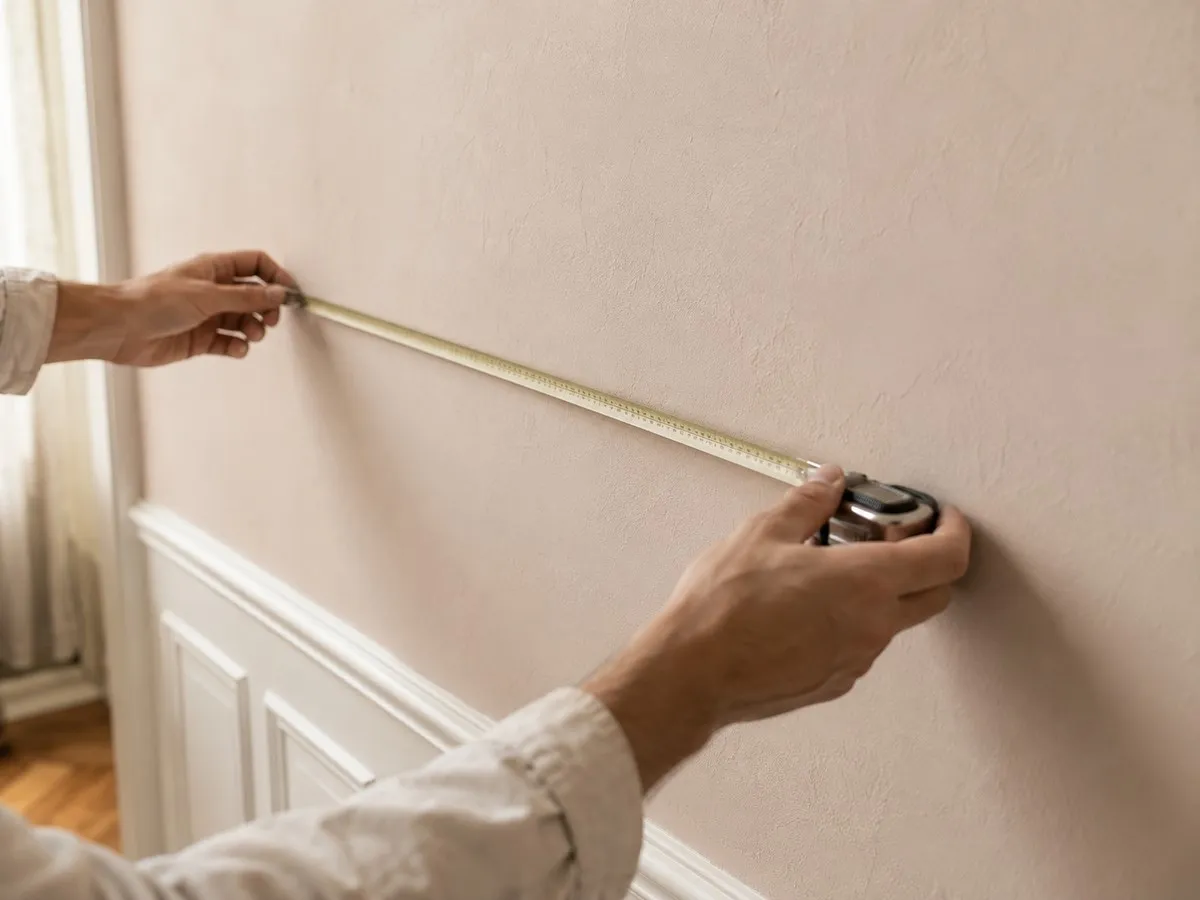
Measure your walls
Add up the length of the walls to be painted, then multiply by the ceiling height. For a whole room, the perimeter is all you need: (length + width) × 2. A 4 m by 3 m bedroom gives 14 metres of walls - under a 2.50 m ceiling, that's 35 m².
For a ceiling it's even simpler: length × width. No need to chase the last centimetre - when ordering, you always round up to the next tin.
Step 2
Deduct the openings
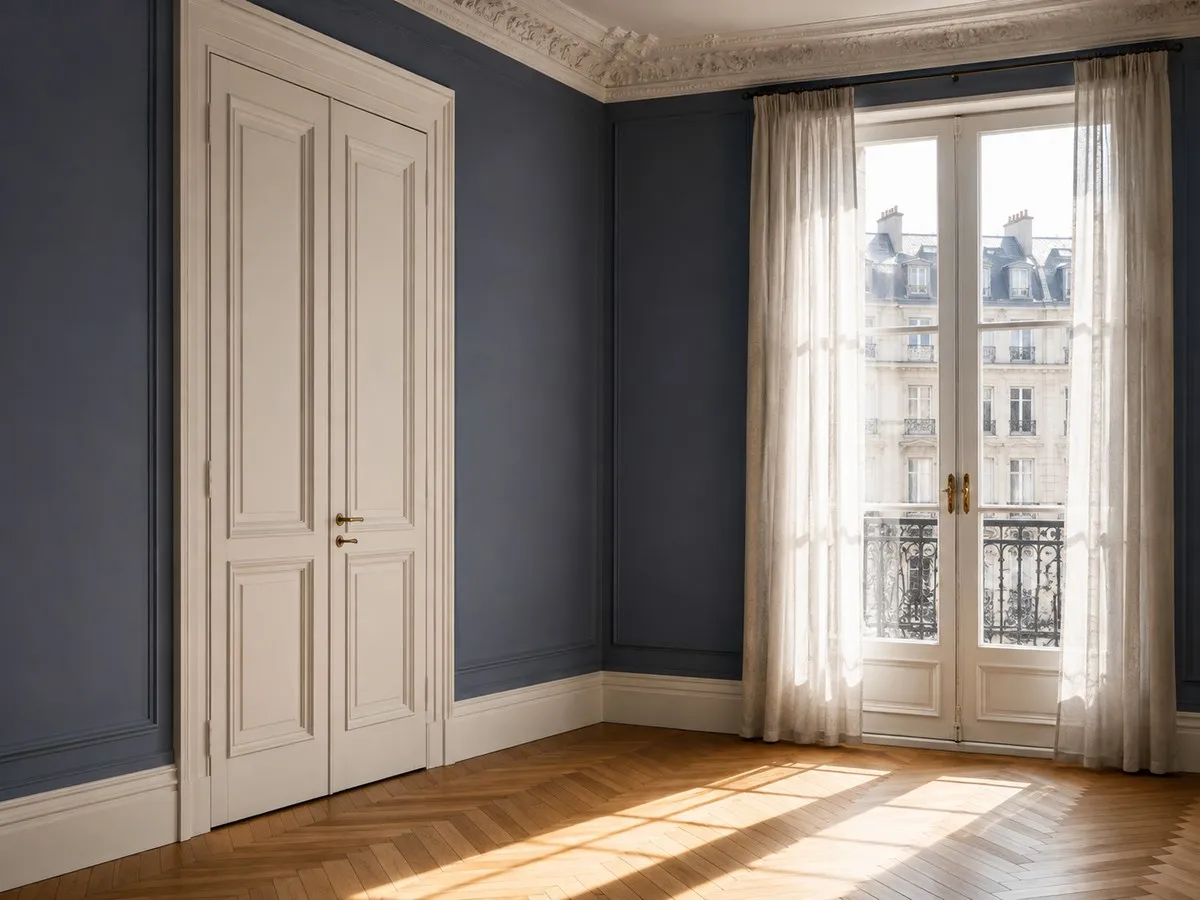
Doors and windows don't get painted - not with the same paint, anyway. Allow roughly 1.8 m² per door and 1.5 m² per standard window, to be subtracted from your surface.
Our 35 m² bedroom, with one door and one window, comes down to 31.7 m². Patio doors? Measure them properly - width × height, like a wall.
Step 3
Count the coats
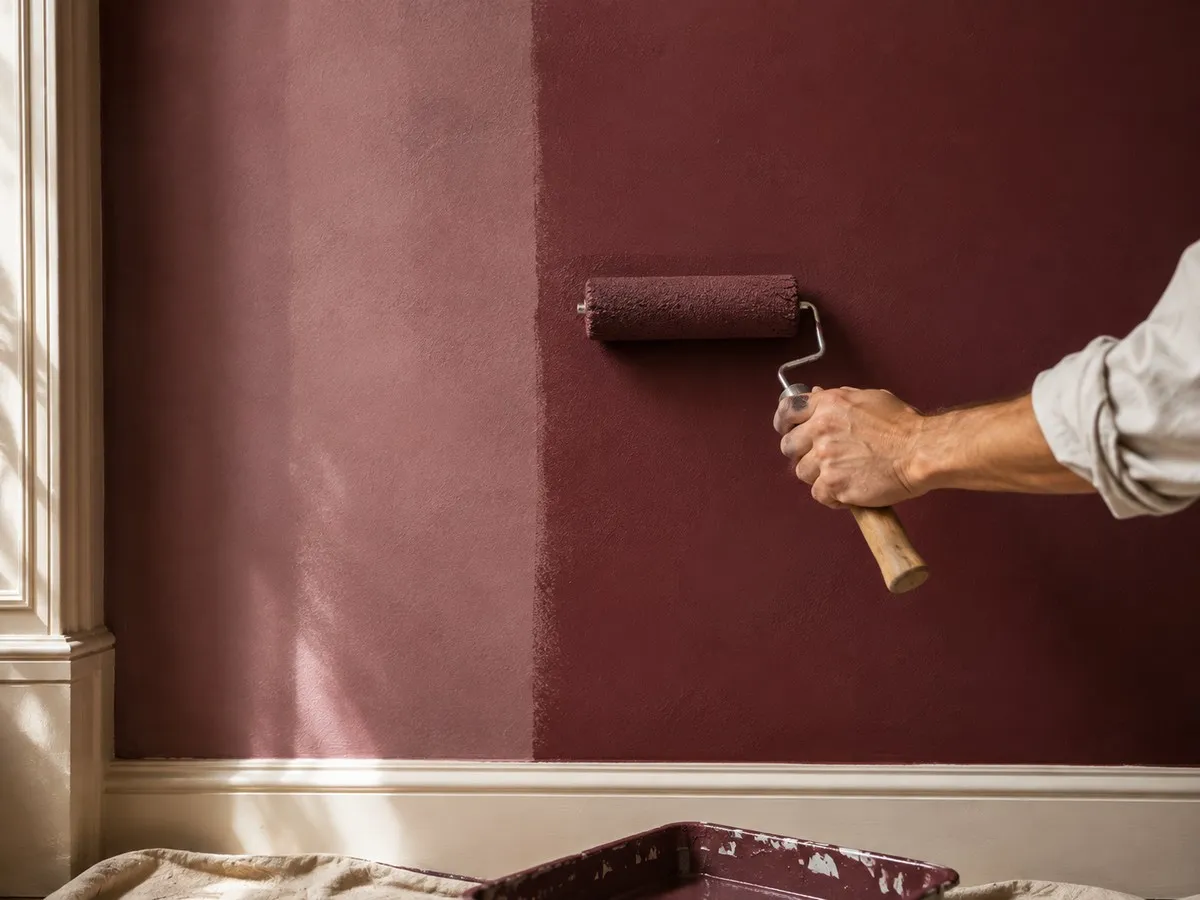
Two coats are the norm for deep, perfectly even colour. Allow three for a radical change - an off-white over a midnight blue - while a single coat can be enough to refresh an identical shade.
On a new, dark or porous surface, the right primer does the thankless work: it guarantees adhesion and often saves an entire finishing coat.
Step 4
Know your coverage
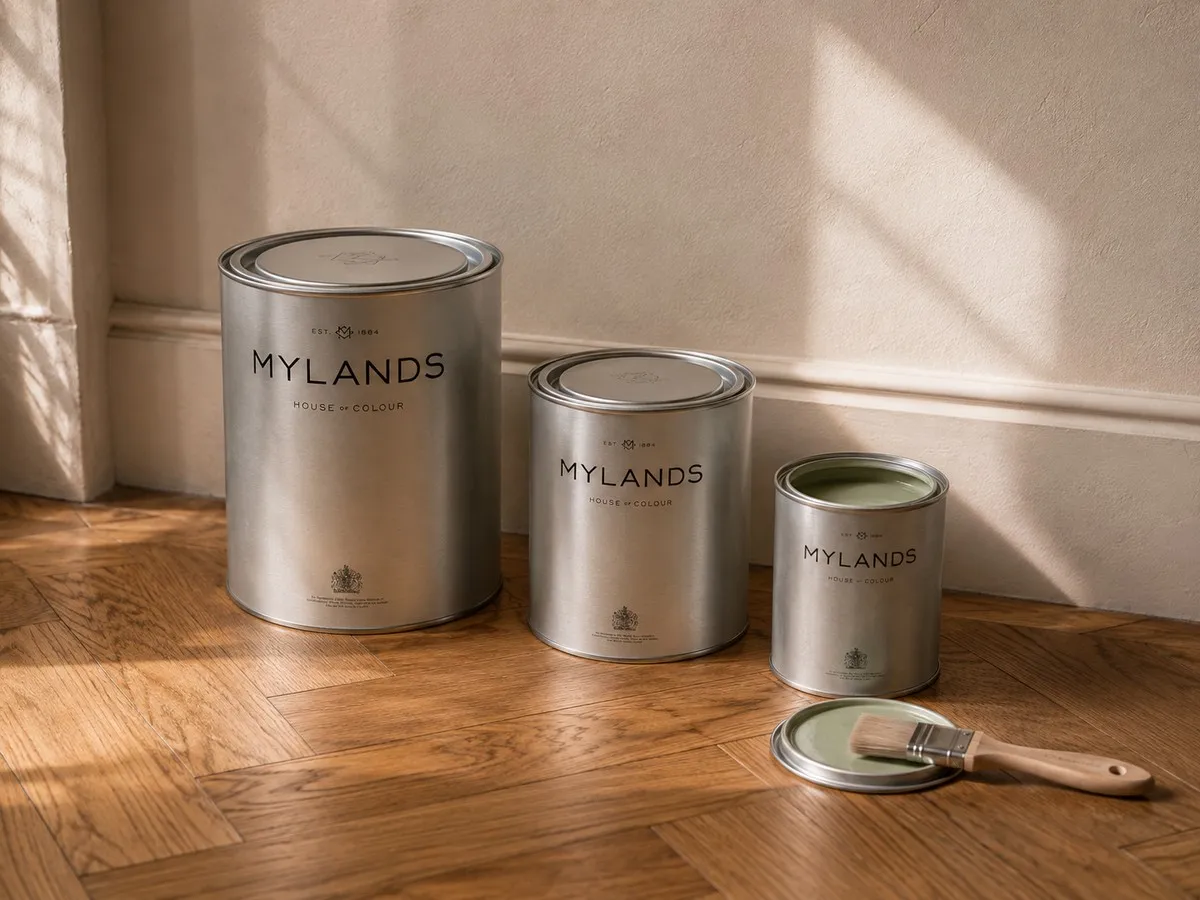
Every finish has its own coverage. Our Marble Matt Emulsion, formulated with crushed Carrara marble, covers up to 15 m² per litre - one of the best rates on the market. Woodwork and multi-surface finishes cover around 12 m² per litre.
The exact figure is on every product page. If in doubt, remember 12 to 15 m² per litre: that's the range across all our paints.
Worked example
A 4 m × 3 m bedroom
The full calculation for a 4 m by 3 m bedroom, 2.50 m high, with one door and one window - in two coats of Marble Matt Emulsion.
- The walls
- (4 + 3) × 2 × 2.50 = 35 m²
- Minus the openings
- 35 − 1.8 − 1.5 = 31.7 m²
- Two coats
- 31.7 × 2 = 63.4 m²
- Coverage 15 m²/L
- 63.4 ÷ 15 = 4.3 L
- To order
- One 5 L tin
- with enough left over for years of touch-ups.
The ceiling? 4 × 3 = 12 m², i.e. 1.6 L in two coats: one 2.5 L tin.
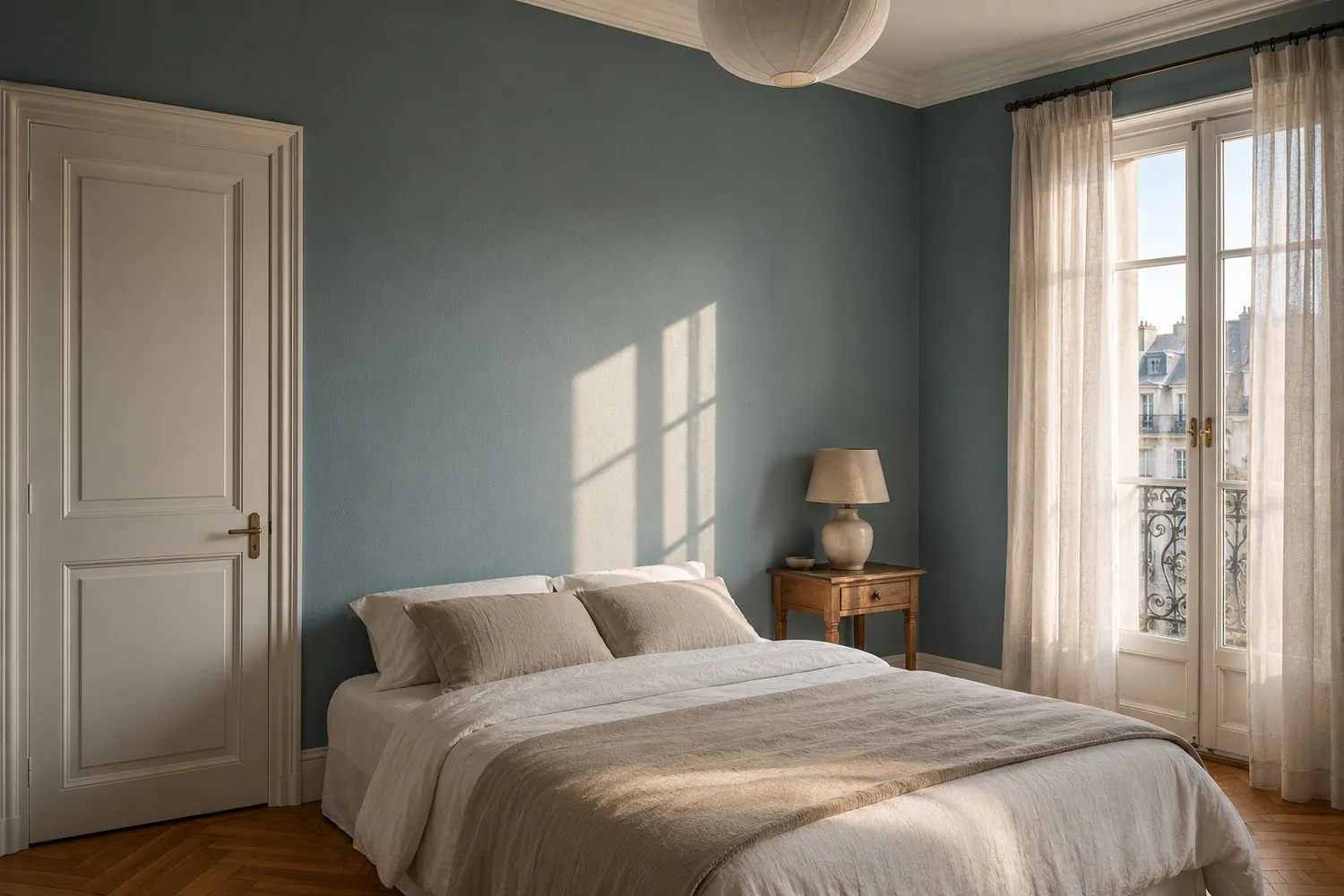
Your turn
The calculator
Describe your room: we'll work out the surface, the litres required and the fairest combination of tins.
Enter your room's length, width and height to start the calculation.
Quick reference
What each tin covers
Based on Marble Matt Emulsion and its coverage of 15 m² per litre.
| Tin | In one coat | In two coats | Ideal for |
|---|---|---|---|
| 100 ml sample | 1.5 m² | 0.75 m² | Testing a shade at home, in every light |
| 1 L | 15 m² | 7.5 m² | A feature wall, a door, a piece of furniture |
| 2.5 L | 37 m² | 18.5 m² | A ceiling, a room's woodwork |
| 5 L | 75 m² | 37.5 m² | A whole room, walls and ceiling |
Indicative coverage of 15 m²/L; allow around 12 m²/L for woodwork and multi-surface finishes.
Our advice
Before you order
Always round up
Better half a litre too many than two walls short. Ordering all your tins at once also guarantees a single production batch - and therefore perfectly uniform colour.
Keep some in the tin
Set aside around 10% for future touch-ups: a tightly closed tin, stored away from frost, keeps for several years.
Sample first
A 100 ml pot covers about 1.5 m²: enough to judge a shade on two opposite walls, in morning and evening light, before ordering your litres.
Remember the primer
On a new, dark or porous surface it guarantees adhesion, seals the background and can save an entire finishing coat.
Frequently asked questions
How many coats should I allow for?
Two coats in the vast majority of cases. Move to three to cover a colour very far from the new one (a light over a very dark, or vice versa), while one may be enough to refresh an identical shade. On difficult surfaces, the right primer beats an extra finishing coat.
Is coverage the same on every surface?
No. Fresh plaster, a porous wall or a first-time paint job absorb more: real-world coverage can drop by 10 to 20%. A smooth, sound, primed surface reaches full coverage. That's why our calculator always rounds up to the next tin.
What if I run out mid-project?
Reorder the same shade - our paints are made to constant recipes - and, as a precaution, always finish a full wall from the same tin: any micro-variation will disappear into a corner, never in the middle of a wall.
What should I do with leftover paint?
Keep some for touch-ups in a tightly sealed tin, stored away from frost. Never pour the surplus down the sink: recycling centres accept tins, even opened ones, and some reuse schemes will give them a second life.
The right amount is the one that lets you finish the last wall without counting - and leaves a little in the tin for the future.


