
Winter sitting room in pale low light, fire lit, a velvet armchair in front of a French window opening onto a frosted garden

Design Advice

Shades of Winter Days

A winter's day is a lesson in scarce light: short, low, silver in the morning, golden for two hours, then blue - and night holds all the rest. It passes through seven shades, and we found them again in our colour card: so that the clarity of frosty days and the warmth of the evenings stay in the house, season after season.

Follow the day's light

Start here

Winter is first of all a light

What we call « winter colours » is not a family of shades - it is an economy of light. In winter the sun rises late, climbs little and sets early: it gives less, but it gives differently - a sideways light, silvered by the sky and the frost, golden for a moment in early afternoon, then blue. The rest belongs to the lamps. The colours we love in January are colours that know how to live with little day and a great deal of evening: light without being cold, deep without being black.

That is exactly what to ask of them once they are home. A successful winter shade keeps two opposite promises: to give back the daylight when there is any, and to become warmth when there is none. Only a generous pigment can manage that - it is the umber, the magenta, the hint of red that stop a winter white turning hospital-grey and a crimson turning brown. Our colours are composed in London with richly weighed pigments - which is why they hold the short days without going out, and why they keep their clarity when spring returns.

Wall painted a pink-tinged white, crossed by a ray of low winter sun and the sharp shadow of a window frame
Winter light does not warm: it silvers. The shades that succeed are the ones that know what to do with it

Your turn

A winter's day, hour by hour

Slide the hour: the frost pales beyond the French window, snow falls, the sun stays low, the blue hour comes early - and the wall takes the shade of the hour. Seven moments, seven shades - this is the page's palette.

The hour 12.30 pm · Noon

12.30 pm — Noon
The hour's shade Holbein Chamber · No.7
Sun low but full, the sharpest light of the day: the shade is exactly « itself », with its hint of pink. This is the hour to judge a winter white. Its room · The hall, the corridors - and every ceiling

An evocation, not a screen-accurate rendering: the true colour is judged from a sample pot, on your wall, at the hour you live in the room. The seven shades are detailed just below.

The palette

Seven hours, seven shades

Every hour of a winter's day has its colour, and every colour its favourite room. Here are the seven, in the sun's order - each with two companions drawn from the Mylands pairings. The chips link to the colour pages.

8.30 am HawksmoorNo.112

Dawn

The silver blue of frost

Winter rises late, and it rises silver: frost has whitened the lawn, the sky is still grey-blue, and the light seems to come from the ground rather than the sky. Hawksmoor carries that moment - « a silver-blue paint, perfect for interior walls and shaded areas », dedicated to the architect of London's great churches and « perfect for quiet contemplation ». On bedroom walls it makes a winter waking a calm, clear thing.
Its room

The bedroom, the morning bathroom

10.30 am SleetNo.91

Morning

The white of falling snow

A winter morning is white - the white of a low sky, of snow that hesitates, of sleet on the panes. Sleet carries its name: « a very light shade of off-white, cool, with an icy hue and slight dirtiness from its greyness ». That hint of grey is everything: it takes the hardness of optical white away and gives it the softness of a snow sky. The shade of a light kitchen or a study that wants all the daylight there is - and there is not too much.

Its room

The kitchen, the study

12.30 pm Holbein ChamberNo.7

Noon

The pink-tinged white of full day

At noon, winter has its hour of clarity - brief, frank, but never harsh: the sun stays low and the light keeps a candle warmth. The white that hour needs is a white with blood in it. Holbein Chamber, inspired by Strawberry Hill House, is « a versatile off-white with a hint of pink » whose « warm, pink glow of the undertones provides a friendly blush to a room ». It is the white of every piece of woodwork in this palette, and of ceilings under which one never wants to feel cold.

Its room

The hall, the corridors - and every ceiling

2.30 pm Floral StreetNo.147

Afternoon

The pale gold of the low sun

Two hours after noon the winter sun is already on its way down, and this is its loveliest moment: it comes in horizontally, crosses the whole room and lays a pale, almost primrose gold on the walls. Floral Street - inspired by Nottingham ochre, « a pigment traditionally used by London colourmen » - is « a delicate, citrus yellow, a light primrose » that « perfectly suits light, sunny rooms ». In a winter kitchen it makes you believe the afternoon will last.

Its room

The kitchen, the breakfast room, the conservatory

5 pm MaritimeNo.236

The blue hour

The deep blue of dusk

At five o'clock winter offers its marvel: the sun has gone, but the sky is slow to go out and everything turns blue - rooftops, snow, window panes. Maritime, « inspired by the boating lake in Regent's Park », is that blue: « a rich, deep blue, a dark, enveloping tone, with a slight red undertone » that gives it « a distinctly unique hue ». In a sitting room or a study it keeps the blue hour all evening - and turns, under the lamp, an astonishing velvet.

Its room

The sitting room, the evening study

7.30 pm HuguenotNo.49

Evening

The crimson by the fire

A winter evening is long, and it happens indoors: by the fire, around a table, in the velvet of theatre seats. Huguenot - « a sumptuous crimson red from our archives, named after the rich silk weavings of the Huguenots » - is that red « with hints of magenta and orange, with darkness and depth which make it thoroughly intriguing », with « a traditional, elegant presence » that creates « a warm, welcoming environment ». The shade of a dining room where one entertains in January.

Its room

The dining room, the library

10.30 pm Market GreenNo.38

Night

The fir green of winter nights

A winter night is not blue like a summer night: it is dark green, like fir trees under snow, like holly hedges. Market Green - named after « the market's iconic iron building » - is « a luxurious, unique and classic deep shade » whose « slight blue undertones help to give a calming effect » and « a natural, outside-in effect ». It is the shade of the winter sitting room where you entertain, of the den of a bedroom: dark by day, sumptuous by night.

Its room

The evening sitting room, the bedroom

Ready to paint

Three winter days, three palettes

One hour does not make a room: it takes a white that breathes, a tonal companion that binds, an accent that wakes. Here are three complete palettes - a morning, an afternoon, an evening - to order as samples or save to your favourites.

01 · Morning

Frosty morning

A frost silver-blue, a clock-face white, a slate grey-blue, and the hint of pink of a holly berry.

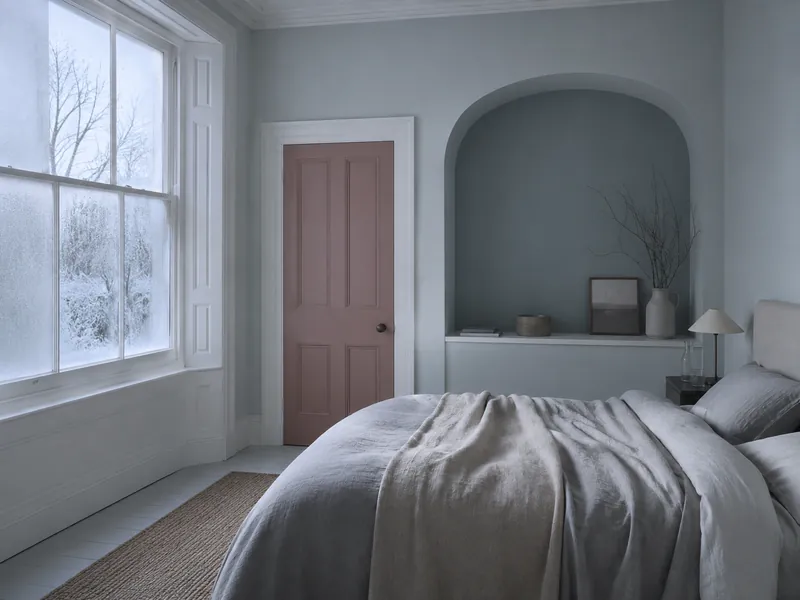
The palette of a bedroom that likes clear, cold mornings - outside. Hawksmoor dresses the walls; Greenwich Time, « a light off-white with blue undertones » named after the Royal Observatory clock face, takes woodwork and ceiling - a related white, not a raw white, which is the whole difference. Long Acre, the « welcoming, friendly » grey-blue of one of our earliest recorded sales of blue, deepens an alcove or the inside of a cupboard. And Covent Garden Floral, Hawksmoor's official accent, a pink « in the alluring space between red and pink, rosy and natural », wakes it all on a door or a bench: the red berry in the frost.

Bedroom with silver-blue walls, cool white woodwork and a floral pink door, frosty morning light
Hawksmoor No.112 on the walls, Greenwich Time No.8 on the woodwork, Covent Garden Floral No.270 on the door

02 · Afternoon

Low-sun afternoon

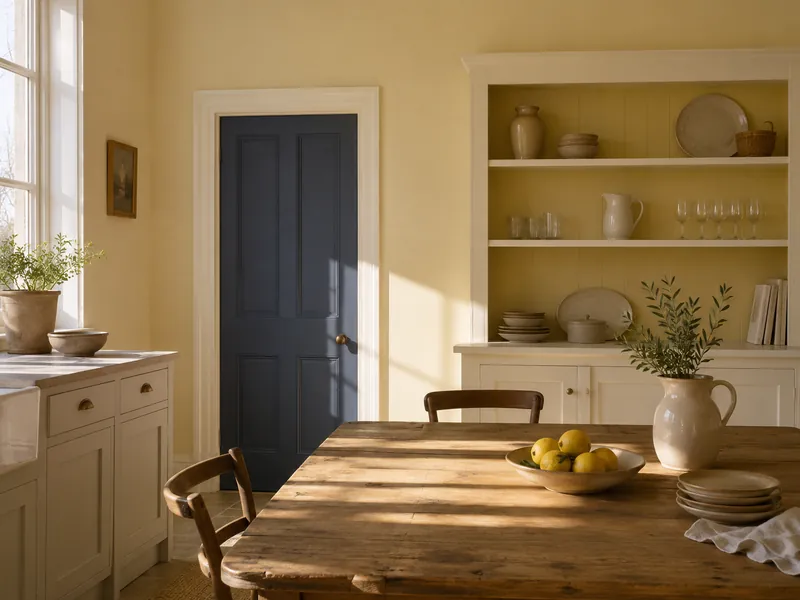
The pale gold of primrose, a serene white, a verdure yellow, and an indigo door like the night to come.

The palette of a kitchen that wants to keep winter's one golden hour. Floral Street covers the walls; Maugham White, the shade's official related white, « serene and traditional », takes the woodwork. Verdure Yellow, its stronger tonal companion - « a pale yellow with hints of green, vibrant and fun » - dresses the inside of the dresser or the island: the same light, a tone higher. Mayfair Dark, « a rich and dramatic indigo » of which Verdure Yellow is precisely the official accent, takes the door - the low note that stops a pale yellow from evaporating.

03 · Evening

Winter evening

A silk crimson, a grey-stone white, an after-dinner plum, and a flash of pale blue like a window onto snow.

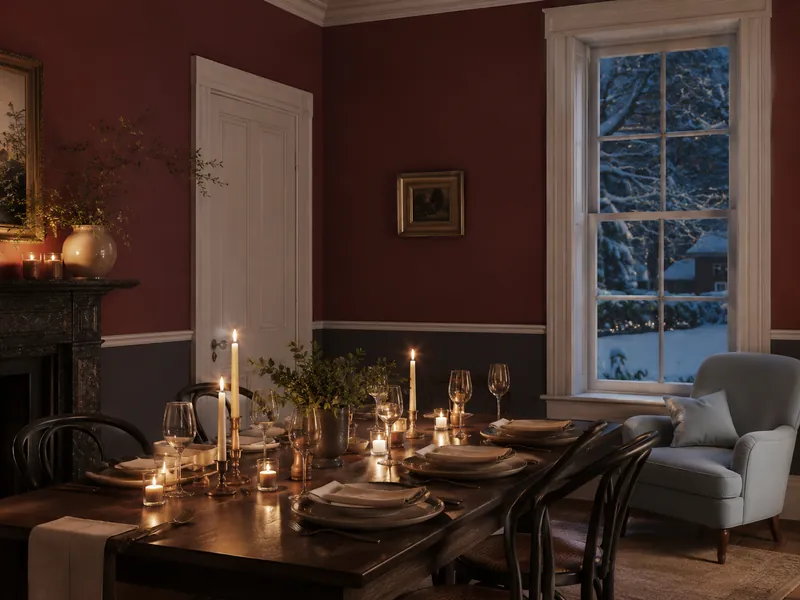
The palette of January dinners that run late. Huguenot wraps the dining room and does, by candlelight, what the blue hour does to window panes. The Boltons - the shade's official related white, a soft, faintly pink grey-white - takes woodwork and ceiling. Plum Tree, « a natural, earthy plum mixed with deep, warm yellows and oranges », dresses the next room or a dado: the same depth, an octave lower. And Notting Hill, a « friendly » blue softened with umber, claims an armchair or the inside of a niche.

Dining room with crimson walls, grey-white woodwork, lit candles and a pale blue armchair by a snowy window
Huguenot No.49 on the walls, The Boltons No.28 on the woodwork, Notting Hill No.213 as the accent

The method

Keeping winter all year round

A winter shade should be as beautiful on a July afternoon as on a January evening. Four rules decorators follow to keep it that way.

01

Never raw white

Factory white, bluish and optical, is exactly what to avoid in winter: it throws the grey of the sky back and chills the room. Give your shades a related white with blood in it - Holbein Chamber, Greenwich Time, The Boltons - and they will keep their light right through to the long days.

02

Matt on the walls, eggshell on the woodwork

Winter light is scarce: it has to be kept without being hardened. A matt emulsion holds it and softens the shadows; an eggshell on the woodwork lets it move just enough under the lamps. Gloss, on the other hand, makes hard reflections through the long evenings - keep it for a door.

03

Look after the lamps

In winter a room lives twice as long under lamps as under daylight. Bulbs between 2700 and 3000 K, several low sources rather than one ceiling light: that is what makes Maritime velvet, Huguenot ember and Market Green deep - and what keeps Sleet and Holbein Chamber warm once night has fallen.

04

Let the materials in

Velvet, boiled wool, dark wood, brass, a sheepskin, the stone of a fireplace: these are the materials that make winter believable when the daylight returns. A winter shade on bare walls is a promise; with the right materials, it is a season.

The neutrals that bind winter: Holbein Chamber · No.7 Sloane Square · No.92 Islington · No.23 Grey Ochre · No.152

Your questions about winter colours

Won't winter colours look cold or gloomy?

The lightest ones will, if left alone under a grey sky: Sleet or Hawksmoor in a north-facing room can grey over in December. Three answers: keep the palette's cool hours (Hawksmoor, Sleet) for rooms that see the sun or are well lit, always pair the shade with a warm related white - Holbein Chamber rather than a raw white - and take care of the evening lighting: bulbs between 2700 and 3000 K give any winter white back its midday light.

Which winter colour for a bedroom?

The two ends of the day: dawn and night. Hawksmoor for those who like to wake in a calm, silver light; Market Green for a refuge of a bedroom that keeps its velvet depth at night and makes for wonderful sleep. In both cases, the ceiling in the shade's related white - and, if the bedroom faces north, Market Green rather than Hawksmoor: the dark green will be warm there where the pale blue would turn cold.

How do I avoid the « Christmas chalet » look?

Through restraint and through company. Red and green together, at scale, is December forever; apart, they are two of the loveliest colours in our archives. Give Huguenot a pale blue - Notting Hill, Bridge Blue - and Market Green a cool white - Saint Johns, Greenwich Time - rather than each other. And keep to one deep shade per room: one bass line is enough for a palette.

A dark shade in a small room in winter - is that sensible?

It is the best idea of the season. A small room does not grow by being painted white; it becomes sharp and cold. Painted in Maritime or Market Green, walls, woodwork and ceiling included, it loses its corners and becomes a jewel box: that is colour drenching, and winter is its season. A low lamp, an armchair, a closed door - and the smallest room in the house becomes the one you want to spend your evenings in.

Can I paint shutters and exterior doors in these shades?

Yes - Market Green, Maritime and Huguenot are among the most classic front-door colours there are. Simply choose a finish made for outdoors (see our exterior selection) and expect the colour to look lighter outside than in the pot: daylight always lightens, and snow even more so. For shutters, then, take the version one tone deeper than the shade you love indoors.

Winter does not fit in one colour: it fits in a scarce light and a lamp. Choose your hour.
Sign up to our newsletter

Sign up to our newsletter

Thanks for signing up to our newsletter!