Design Advice
Ways of Decorating
There is no single way to paint a room - there are six, from an afternoon's gesture to the full envelope. Their effects, their golden rules, and a palette for each.
Try the six waysStart here
Every room has its way
Colour is not one decision, it is a decision about geography: where does it stop, where does it begin? On one wall or on all six faces of the room? On the doors, below a rail, up on the ceiling? The same shade tells six different stories depending on the surface you entrust it with.
That is the good news this page would like to give you: decorating is not choosing the right colour - it is choosing a gesture. Some take an afternoon and one tin; others commit the whole room. Each has its golden rules, and each has its palette. Here are the six ways, from the lightest touch to the most enveloping.
Your turn
One room, six ways
The same sitting room, six outfits. Switch from one way to the next and watch what changes: where the colour stops, what it enlarges, what it puts on stage.
The way
Eaton Square No.232 · Saint Johns No.64 · London Brick BH.07
The repertoire
The six ways, one by one
Each way comes with its golden rule, its bearings - effect, effort, best rooms - and a ready-to-paint palette built from official Mylands pairings. Every swatch links to its colour.
01 · The opening gesture
The feature wall
One wall in colour, the rest at rest: the first step - and sometimes the only one needed.
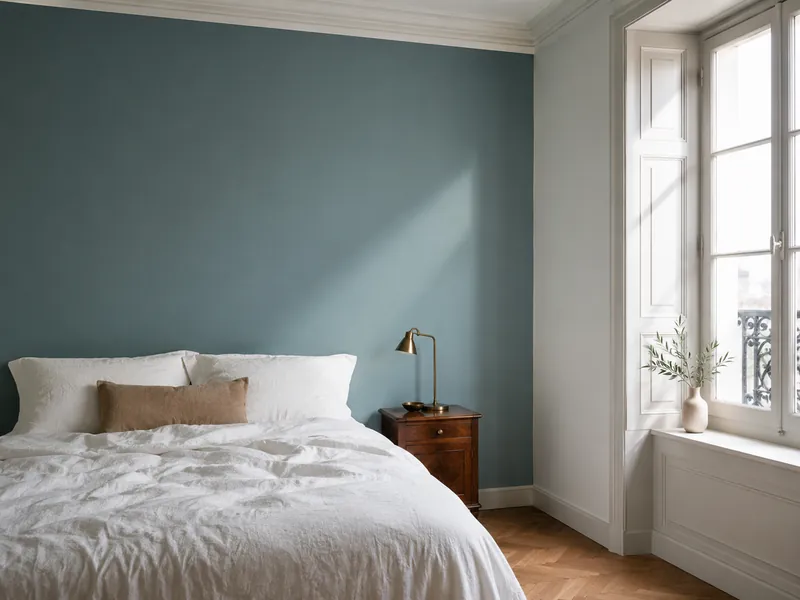
It is the simplest way to let colour in, and the most unfairly mocked: well chosen, a feature wall structures an entire room. It frames a purpose - the bedhead, the fireplace, the sofa, the desk - and gives the eye somewhere to arrive.
Everything rests on choosing the wall. Light and architecture nominate it themselves: the wall you face as you enter, the one carrying the chimney breast or the alcove. Never the window wall - against the light, colour reads as shadow. The other three walls stay in a related white, never a raw one.
- Effect
- Frames and adds depth
- Effort
- Half a day, one tin
- Best rooms
- Bedrooms, sitting rooms, studies
02 · Architecture, underlined
Woodwork in the lead
Quiet walls, strong joinery: colour draws the doors, skirting and frames.
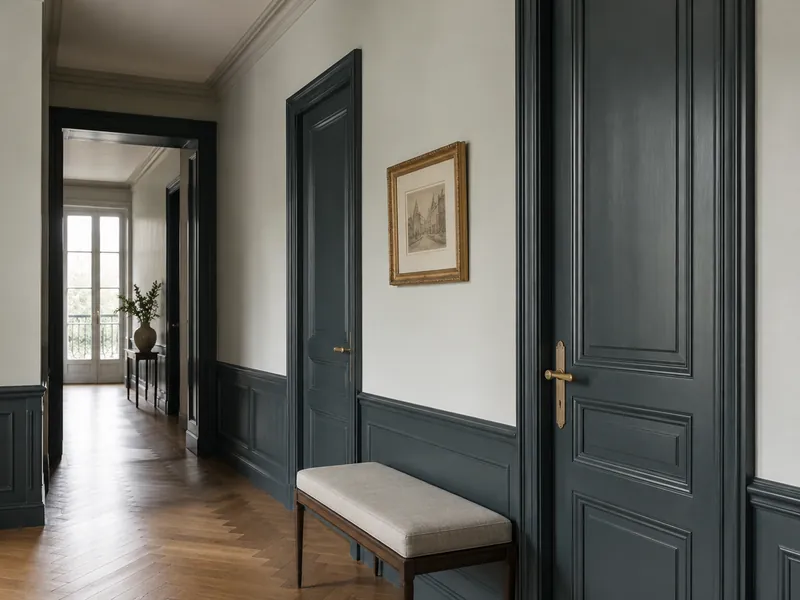
Reverse the convention: let the walls step back and hand the colour to the woodwork. Doors, skirting boards, frames, cornices - painted in a deep shade, they stop being « finishing touches » and become the drawing of the room, the way an ink line sharpens a sketch.
It is the way of hallways and corridors, where doors come one after another - and the kindest way to imperfect walls: the eye follows the line, not the plaster. A finish one step sheenier than the walls - Eggshell or Satin - keeps the gesture crisp and washable.
- Effect
- Draws the architecture, instant polish
- Effort
- A weekend of precision
- Best rooms
- Hallways, corridors, studies
03 · The fifth wall
The coloured ceiling
Well-behaved walls, an unexpected sky: colour where nobody looks for it.
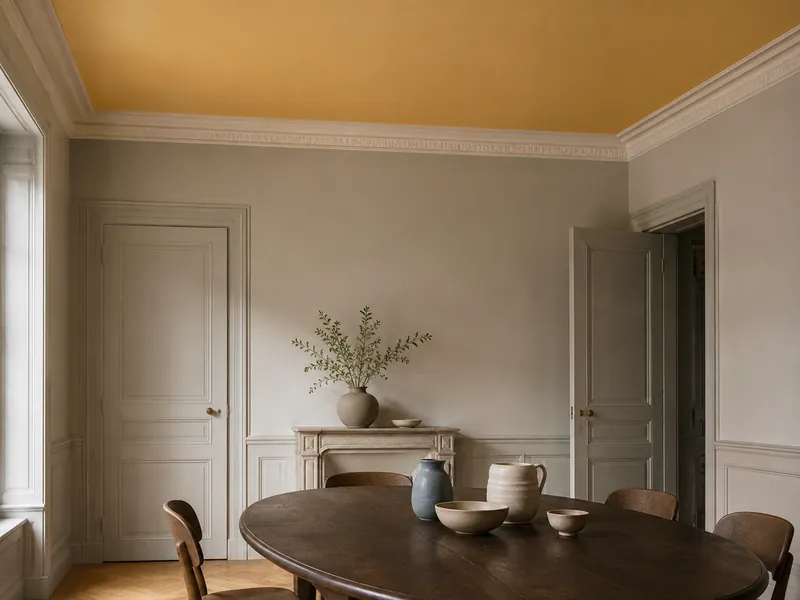
The ceiling is the wall everyone forgets - and the largest uninterrupted plane in the room. Painted in a chosen shade, it draws tall volumes closer, warms rooms that have gone too white, and makes people look up - which very few decorating gestures achieve.
A golden yellow up there manufactures permanent light - the shade reflects gently onto everything living below. A powdery tone hangs a bedroom sky. The material rule is absolute: matt, always, to forgive the flaws that raking light loves to reveal.
- Effect
- Draws in and warms the light
- Effort
- One tin, a little neck-ache
- Best rooms
- Bedrooms, dining rooms, eaves
04 · The two-tone classic
The dado
Deep below, light above: the old houses' gesture, built for real life.
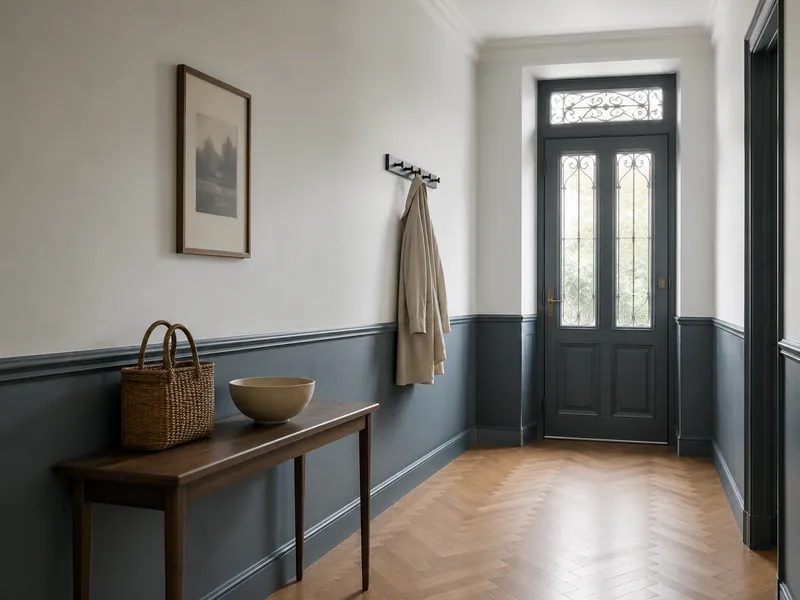
Two colours on one wall, parted by a line: the dado is the oldest way of decorating - and one of the cleverest. The deep tone below anchors the room and shrugs off traffic, shoes and school bags; the light above keeps the air and the daylight.
The line can be a true dado rail, an existing picture rail, or a simple stripe of masking tape pulled level. It lends hallways, corridors and staircases the rhythm of architecture - even where the architecture never planned any.
- Effect
- Grounds the room, wears daily life well
- Effort
- Masking tape and patience
- Best rooms
- Halls, corridors, staircases, children's rooms
05 · The learned softness
Tonal layering
One colour family, played value by value: depth without contrast.
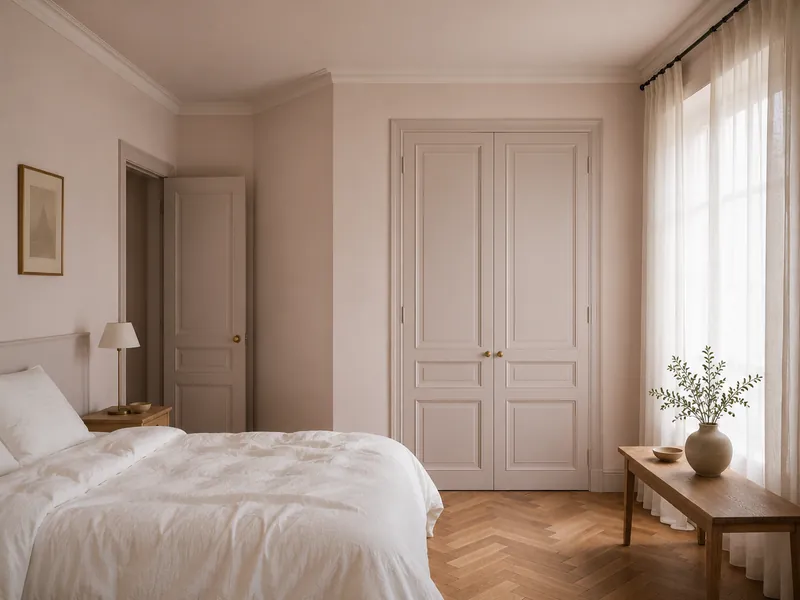
Take a shade you love, then its family neighbours: a lighter value for the ceiling, a deeper one for the woodwork. The room gains a subtle relief - every surface distinct, none interrupting the others.
It is the way that forgives everything: no hard border, no irreversible choice, and an elegance that comes from restraint. Our official pairings hand you the families ready-made - every Mylands colour knows its neighbours, composed to live together.
- Effect
- Softness and relief without contrast
- Effort
- Easy - the way that forgives
- Best rooms
- Bedrooms, light sitting rooms, main suites
06 · The total gesture
Colour drenching
Walls, woodwork, ceiling: one shade, worn with conviction - the complete envelope.
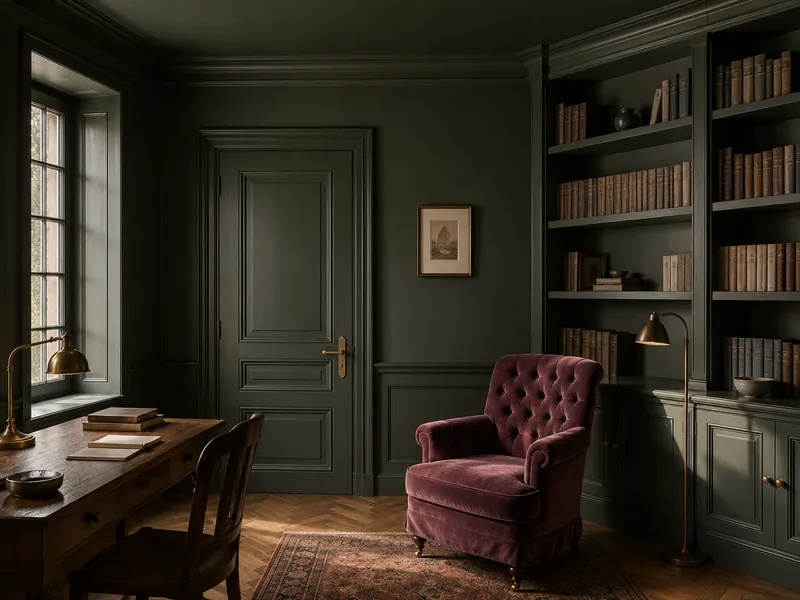
The most committed way - and the most rewarded. One colour dresses every surface: walls, doors, skirting, radiators, ceiling. Boundaries dissolve, the room becomes one continuous volume, and everything left unpainted - brass, wood, pictures - begins to shine.
Counter-intuitive and spectacular, it works wonders in small, complicated rooms and in evening rooms. It has earned its own guide: the definition, complete palettes, finishes and advice - everything is there.
- Effect
- Dissolves boundaries, envelops
- Effort
- A commitment - guided step by step
- Best rooms
- Studies, dining rooms, small rooms
Help choosing
Choosing your way
Six gestures, six temperaments. The table sets them side by side - click a way to return to its chapter.
| The way | What it does | Effort | Best rooms |
|---|---|---|---|
| The feature wall | Frames and adds depth | Half a day, one tin | Bedrooms, sitting rooms, studies |
| Woodwork in the lead | Draws the architecture, instant polish | A weekend of precision | Hallways, corridors, studies |
| The coloured ceiling | Draws in and warms the light | One tin, a little neck-ache | Bedrooms, dining rooms, eaves |
| The dado | Grounds the room, wears daily life well | Masking tape and patience | Halls, corridors, staircases, children's rooms |
| Tonal layering | Softness and relief without contrast | Easy - the way that forgives | Bedrooms, light sitting rooms, main suites |
| Colour drenching | Dissolves boundaries, envelops | A commitment - guided step by step | Studies, dining rooms, small rooms |
The rules of the art
Whichever way you choose
The 60-30-10 rule
One dominant (about 60% of the room), one secondary (30%), one accent (10%). Every way on this page honours it in its own manner - and when a room « doesn't work », it is almost always this proportion that has slipped.
Repeat every colour twice
A colour placed once floats; placed twice - the wall and a cushion, the door and a vase - it belongs to the room. It is also the secret of a coherent home: carry a shade from one room into the next, simply changing the way you use it.
Test at scale, on two surfaces
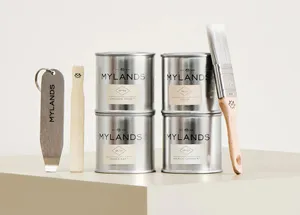
A sample is judged large - 50 × 50 cm at least - on a wall AND a piece of woodwork, morning and evening. Our 100 ml pots exist for this, and our visualiser lets you try each way on a photograph of your own room.
The finish is part of the colour
The same shade changes character with its material: matt on walls and ceilings, eggshell or satin on woodwork that works for a living. Every Mylands colour exists in all our finishes - which is what makes every one of these ways possible without ever changing reference.
Your decorating questions
How many colours can one room take?
Three confident shades, plus your whites: beyond that, a room starts to shout. The 60-30-10 rule shares them out - one dominant, one secondary, one accent. Tonal layering elegantly sidesteps the question: three values of one family read as a single colour to the eye.
Which way suits a small, dark room?
Not the one you think. Piling on whites does not brighten a dark room - it turns it grey. A warm tonal scheme softens it, and drenching it in a deep shade turns it into a jewel case: boundaries vanish and the volume reads larger. The lone feature wall is the one trap - it cuts a small room in two.
Can you combine several ways in one room?
Yes - the loveliest rooms do. A dado gets along beautifully with a coloured ceiling; woodwork in the lead extends a tonal scheme naturally. Just keep one dominant way and one shared palette: every Mylands colour's official pairings are made for moving between gestures without a wrong note.
Where do I start if I hesitate?
With the least intimidating room: an entrance, a corridor, a guest cloakroom. Choose a way, order the 100 ml samples of its palette, paint large on two surfaces and live with it for a few days. Our online visualiser also lets you try each gesture on a photo of your room before opening a tin.
Should the whole house share one palette?
A thread, yes; a uniform, no. The most elegant homes let colours travel while the way changes: the hallway's dado shade becomes the sitting room's feature wall, then the study's full drench. The house holds together, and every room keeps its temperament.
Colour does not ask for courage. It asks for an intention - and the way that serves it.