

Indoor air

Low-VOC, low-odour paint

No paint is entirely odourless, but a low-VOC water-based paint comes close. Mylands decorative paints are water-based, low in volatile organic compounds and compliant with the EN 71-3 toy standard: the smell is discreet, disperses with normal ventilation, and rooms can be used again quickly. Here is what those words cover — and what they do not.

Page updated September 2026

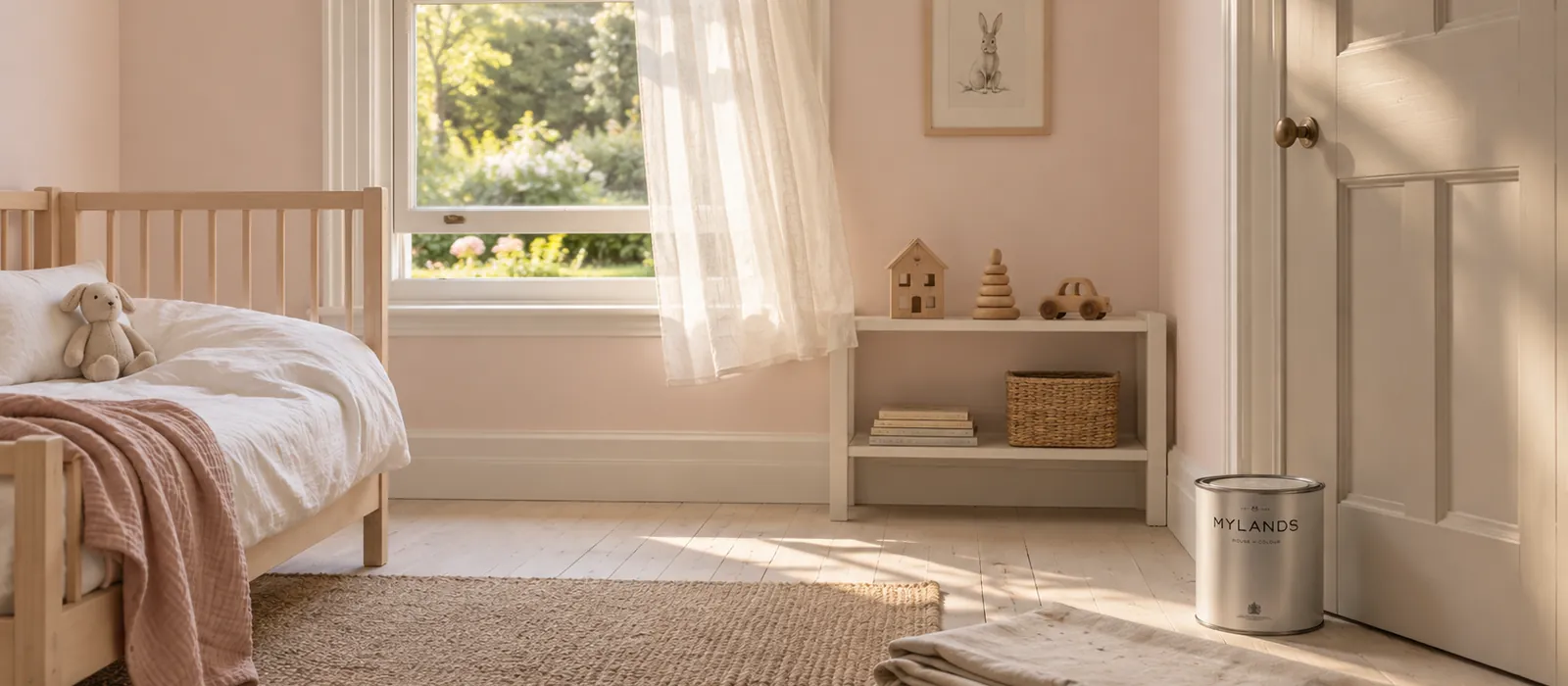
A child's bedroom freshly painted in powder pink, window ajar onto a garden, cot and wooden toys
Painted in the morning, back in use by evening: low-VOC water-based paint

Understanding

What a VOC is, and why it matters

Volatile organic compounds are the substances that evaporate from a paint during and after application — essentially, what you smell. In a solvent-based paint they are abundant and linger for days; in a water-based paint the main "solvent" is water itself, and the remaining VOCs are counted in grams per litre.

They matter for two reasons: comfort — a freshly painted room you can use again the same evening — and indoor air quality, where the emissions of paints, glues, furniture and floor coverings accumulate. Hence a European regulation on VOC content and, in France, a label on emissions.

What the law says

Two reference points: VOC content and the A+ label

Content. European directive 2004/42/EC caps the quantity of VOCs a paint may contain, category by category: 30 g/L for an interior matt wall paint (category a), 100 g/L for a glossy wall paint (b), 130 g/L for wood and metal trim paints (d). Every paint sold in Europe meets these caps; the best sit far below them.

Emissions. In France, since decree no. 2011-321 and the order of 19 April 2011, every tin carries the "Émissions dans l'air intérieur" label, from A+ (very low emissions) to C. It measures not what the tin contains but what the painted surface still gives off 28 days after application, for ten substances including formaldehyde and total VOCs. Each product's class is on its tin and its data sheet.

Two labels, two questions: the content says how much VOC evaporates during the work; the emissions label says what is left to breathe a month later. A good interior paint is low on both.

And Mylands?

What a Mylands tin contains — and does not

01

Water-based, low VOC

All our decorative paints are formulated in water: discreet smell, fast drying, tools washed without solvent. The formulations are low in volatile organic compounds — better air quality during and after the work, and rooms back in use sooner.
02

Compliant with the EN 71-3 toy standard

The European standard EN 71-3 limits the migration of heavy metals from surfaces children touch and put in their mouths. Our paints comply: they are suitable for children's bedrooms, furniture and wooden toys.

03

Natural ingredients

Natural earth and mineral pigments for colour, natural fillers — including the crushed Carrara marble in our matt emulsion — and binders of natural origin wherever possible. A paint that comes from the ground more than from petroleum.

04

Breathable, on old walls

Marble Matt Emulsion lets walls release their moisture instead of trapping it — a point that matters for the health of old houses, plaster and lime, beyond the question of VOCs alone.

What we do not say: "VOC-free" or "odourless". A water-based paint always contains a few grams of VOC per litre and smells, faintly, while it dries. The exact values for each product are on its technical data sheet.

In practice

Paint, ventilate, move back in

  • During the work: window ajar, door closed to the rest of the home; ventilation, more than the formula, is what makes the smell disappear.
  • Drying: Marble Matt Emulsion is touch-dry in 1–2 h and recoatable after 3–4 h; the multi-surface finishes are touch-dry in 2–3 h. Keep airing for a few hours after the last coat.
  • Using the room again: with a low-VOC water-based paint, a bedroom painted in the morning can generally be used that evening, once dry and aired. For a baby's room or someone sensitive, leave one more night with the window ajar.
  • Curing: the film goes on hardening for two to four weeks; that is the wait before firm cleaning, not before living in the room.
  • Leftovers: an empty, dry tin goes in the packaging recycling; a tin with paint still in it is hazardous household waste, for the recycling centre — never the sink.

Frequently asked

VOCs, smell, children's rooms

Is Mylands paint VOC-free?

No — and no paint really is. Mylands paints are water-based and low in VOCs: what remains is counted in grams per litre, far below the regulatory caps, and evaporates quickly. "VOC-free" is a marketing claim we prefer not to make; "low VOC" is what we can guarantee.

Can you sleep in a freshly painted bedroom?

With a low-VOC water-based paint, yes, generally the same evening: once the last coat is touch-dry and the room has been aired for a few hours, the residual smell is faint. For an infant, a pregnant woman or someone sensitive to smells, wait one more night with the window ajar — as a precaution, not an obligation.

Are Mylands paints suitable for a child's bedroom?

Yes. They are water-based, low in VOCs and compliant with the EN 71-3 toy standard, which governs surfaces children touch and mouth — walls, furniture, cots, wooden toys. Choose Marble Matt Emulsion for the walls (washable, class 1: fingermarks sponge off) and a multi-surface finish for furniture.

What does the A+ label on a tin of paint mean?

It is the best class of the French "Émissions dans l'air intérieur" label (A+ to C), compulsory on paints sold in France. It measures what the painted surface still emits 28 days after application, for ten pollutants including formaldehyde and total VOCs. Each Mylands product's class is on its tin and its data sheet.

Which Mylands finish smells the least?

All our decorative finishes are water-based. Marble Matt Emulsion, the fastest to dry, is also the one whose smell disperses fastest; the multi-surface finishes (Dead Matt, Eggshell, Satin, Gloss) dry a little more slowly and want an hour or two more of airing. In every case the smell is nothing like that of a solvent-based paint.

Is a water-based paint as tough as a solvent-based one?

Today, yes, for decorative use: our matt wall paints reach class 1 wet-scrub resistance, our multi-surface finishes go on wood and metal inside and out, and Multi-Surface Gloss is our most durable finish. Solvent is no longer a condition of toughness — it was true twenty years ago, it is not any more.

References

Directive 2004/42/EC of the European Parliament and of the Council (maximum VOC contents, Annex II); French decree no. 2011-321 of 23 March 2011 and order of 19 April 2011 on the labelling of volatile pollutant emissions of construction products and paints (A+ to C label, measured at 28 days); EN 71-3 (safety of toys, migration of certain elements); EN 13300 (classification of interior wall paints). The Mylands characteristics quoted are those of our Glossary and Find your finish pages and our data sheets.

"A beautiful colour should never be something you breathe."
Sign up to our newsletter

Sign up to our newsletter

Thanks for signing up to our newsletter!