

Help with woodcare How-to guides

How to oil a wooden floor with hard wax oil

A wooden floor is oiled in two thin coats of Hard Wax Oil, applied along the grain 24 hours apart, on wood sanded to 120-150 grit and perfectly dust-free. Excess is removed at once, the surface is touch-dry in 6 to 8 hours, nobody walks on it for 24 hours and full cure takes 7 to 10 days. The result: a matt floor, UV resistant and spill proof, cleaned with Floor Cleaner and repaired locally.

Page updated September 2026 · by the Mylands France woodcare specialists

Why oil

What hard wax oil does to a floor

A hard wax oil does not form a film sitting on the wood: the oil penetrates the fibres and the wax hardens at the surface. The floor keeps its touch and its matt, it resists spills and UV, and above all it repairs without redoing everything: a scratch is lightly sanded and dabbed with fresh oil, a dulled corridor gets a maintenance coat. That is why the flooring trade uses it so much. Mylac lacquer makes a harder film but is redone by whole area: the choice between the two is in Which wood finish to choose.

Success comes down to one thing: the wood must be able to absorb the oil evenly. Hence sanding that stops at 120-150 grit — finer, the wood burnishes and blocks penetration —, the complete removal of any old wax, oil or lacquer, and dusting with nothing left behind. The seven moves below apply to a new floor as to an old one re-sanded to bare wood; the general method is in Hard wax oil, explained.

The method

Oiling a floor in seven moves

Allow two days for the two coats, then a week of care. Work in a temperate room: an oil does not dry in the cold.

  1. 01

    Sand through the grits, up to 120-150

    From 80 grit to 120, then 150 to finish, without skipping a step. Never sand finer on a floor: burnished wood stops drinking. Every trace of old wax, oil or lacquer must be gone; on an old floor, go down to bare wood.

  2. 02

    Vacuum, then go over with a tack cloth

    Sanding dust is the enemy: it sets in the oil and makes lumps. Vacuum the floor, the skirting and the window sills, then wipe with a tack cloth until it comes back clean.

  3. 03

    Stir, then spread a thin first coat along the grain

    Stir the tin thoroughly. With a floor brush or a short-pile roller, apply a thin, even coat along the boards, working the oil well into the fibres. Work in manageable sections to keep a wet edge.

  4. 04

    Remove any excess immediately

    Wherever the oil shines or pools, wipe at once with a lint-free cloth: what stays on the surface goes tacky and never dries. The floor should look nourished, not wet. Touch-dry in 6 to 8 hours.

  5. 05

    Wait 24 hours; de-nib with 240 if the grain has raised

    The next day, run your hand over it: if the wood feels slightly rough, a light de-nib with a fine pad, 240 grit or finer, then dust off again. If the surface is smooth, go straight to the second coat.

  6. 06

    Second coat, more sparing than the first

    Same move, same direction, but less product: the wood has already drunk. Two coats are enough for domestic and commercial use; an additional coat increases durability further in a hallway or a shop.

  7. 07

    24 hours without traffic, 7 to 10 days of care

    No heavy traffic for 24 hours. Full chemical cure takes 7 to 10 days: no rugs, no dragged furniture, no washing until then. Afterwards, Floor Cleaner or a damp cloth for routine cleaning.

The tints

Natural or tinted: hard wax oil by floor

Hard Wax Oil comes in Natural and six tints, applied in exactly the same way. A tint colours and protects in one operation; always test on an offcut or inside a cupboard, because each wood renders it differently.

01

Natural on an oak floor

The classic: the oak keeps its honey colour, barely warmed, with a matt that shows the grain and the pores. Two thin coats in a sitting room, a corridor or a bedroom; the floor is washed with Floor Cleaner and refreshed with a thin coat when it dulls.
02

Crushed Marble on a pale ash floor

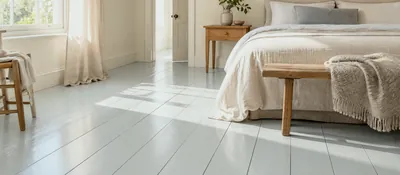
To keep a pale wood truly pale: the whitened tint gives ash, light oak or pine a Scandinavian, almost chalky look without hiding the grain. On oak the effect is softer and warmer than on pine, where it reads cooler.

03

Castanea on pine boards

A chestnut brown that calms the orange of pine and evens up boards of uneven colour. On a softwood the first coat is drunk fast: keep it thin and wipe without waiting, as the soft zones of the wood drink more than the hard ones.

04

Wenge on a dark floor

The deep brown-black of reception-room floors: on walnut, fumed oak or an oak you want to darken, Wenge gives a dense, even colour in the same matt as Natural. Two coats, the second very sparing to avoid overlap marks.

Room by room

How many coats for which room

RoomTrafficCoatsThe advice
Bedroom, study Light Two thin coats Twenty-four hours between them; furniture comes back after 7 to 10 days
Sitting room, dining room Medium Two thin coats Remove excess carefully under the windows, where raking light shows everything
Hall, corridor Heavy Two coats, a third possible Each additional coat increases durability; a doormat at the entrance once the floor has cured
Kitchen Heavy, spills Two coats, a third possible Spill proof: wipe without waiting, wash with Floor Cleaner, never a puddle
Stairs Very heavy Two coats Every other tread to keep the stair usable: see Finishing a wooden staircase
Shop, restaurant Intensive Two coats, plus one Designed for high-traffic areas; a maintenance coat as soon as the floor dulls

Touch-dry: 6 to 8 hours. Between coats: 24 hours. No traffic: 24 hours. Full cure: 7 to 10 days. Upkeep: Caring for an oiled or varnished wooden floor.

To avoid

What spoils an oiled floor

  • Letting the excess dry. A pool of hard wax oil never dries properly: it stays tacky and holds dust. Wipe at once, not the next day.
  • Sanding too fine. Beyond 150 grit the floor burnishes and the oil sits on top. 120-150 is the rule, not an approximation.
  • A second coat as heavy as the first. The wood no longer absorbs: brush marks and shiny patches. The second coat is sparing.
  • Walking too soon. Twenty-four hours without traffic, and 7 to 10 days before rugs and heavy furniture: the wax cures chemically and cannot be hurried.
  • Oiling over a trace of old finish. A remnant of wax or varnish blocks penetration in patches: the floor blotches. Everything must have gone in the sanding.
  • Bundled rags. Oily rags can ignite on their own: soak them in water or lay them flat outside.

Frequently asked

Your questions, our answers

Can I oil a floor that is already varnished or waxed?

Only after re-sanding it to bare wood. Hard wax oil has to penetrate the fibres: the slightest trace of varnish, lacquer or wax blocks it and the floor blotches. Full sanding with 80 grit, then 120 and 150, dust off, and the method starts again at the first coat.

When can I put the furniture and rugs back?

Light traffic after 24 hours, in socks. Furniture goes back carefully after 24 hours, without dragging; rugs and heavy pieces wait for full cure, 7 to 10 days, or they mark the still-soft wax.

Is one coat enough on a little-used floor?

Two coats are the rule, even in a bedroom: the first feeds the wood, the second builds the protection. In a hall, a kitchen or a shop, a third coat increases durability further. Each coat is thin, and the second more sparing than the first.

How do I fix a scratch or a dulled area?

That is the advantage of hard wax oil. A scratch: light sanding of the spot, a dab of fresh oil, wipe. A dulled corridor: clean with Floor Cleaner, then a thin coat over the whole area concerned. No repair shows after a few days.

Do I need a special cleaning product?

Floor Cleaner, a low-foaming cleaner for all wood floors, with a mop or a machine, or simply a damp cloth. Never a harsh cleaner or a puddle of water: the floor is wiped, not soaked.

“Thin, along the grain, and the excess off at once: the rest is patience.”
Sign up to our newsletter

Sign up to our newsletter

Thanks for signing up to our newsletter!