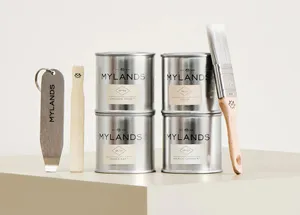

01
Solid oak, Wood Finishing Oil
The most common kitchen worktop, and the most versatile oil: three coats warm the oak by a shade of honey and give it a living matt that repels water. Oak tannins do not like standing water: wipe around the sink.
Menu
How To
Design Advice
Customer Service
My account
Help with woodcare How-to guides
A wooden worktop is oiled in three coats of Wood Finishing Oil, Pure Tung Oil or Food Safe Oil, on bare, dry wood sanded to 180 grit at most. Each coat goes on generously, soaks for 5 to 10 minutes, is wiped along the grain, then — the rule that decides everything — all the oil still wet is wiped off at 20 minutes, or it goes tacky. Next coat after 12 to 18 hours. Afterwards, a maintenance coat as soon as water stops beading, every 3 to 6 months depending on use. For a harder film, Hard Wax Oil Natural is the alternative.
Page updated September 2026 · by the Mylands France woodcare specialists
Why an oil
A worktop lives under knives, water, heat and vinegar. A film would protect it, but every cut would open it and the whole thing would need redoing. An oil goes into the fibres instead of covering them: the wood still feels like wood, it repels water, and a mark is repaired locally, with a cloth, without sanding the whole top. It has always been the finish for worktops, tables and chopping boards.
Three oils in the range suit. Wood Finishing Oil, tung-based, the all-purpose interior oil made for worktops, tables and furniture in constant use. Pure Tung Oil, a drying oil resistant to heat, water, alcohol, food and acids, for a kitchen or bathroom worktop. Food Safe Oil, tasteless and odourless, for chopping boards, butcher's blocks and salad bowls. All three are applied the same way; only Hard Wax Oil Natural follows a different method, described below, for anyone who wants a harder film.
The method
Three days for three coats, 12 to 18 hours apart, in a temperate kitchen: an oil does not dry in the cold.
The worktop must be bare, free of any film-forming finish, and below 18% moisture. Sand with 120 then 180 grit, never finer: burnished wood stops drinking. On an oily exotic timber, iroko or teak, degrease first with Cellulose Thinners.
Vacuum, then tack cloth. The front edge, the sink cut-out and the hob cut-out are end grain: they drink more than the face and are the first to suffer from water. They get the same attention at every coat.
With a brush or a clean cotton cloth, spread the Wood Finishing Oil liberally, without economy, over the whole surface. Let the wood drink for 5 to 10 minutes; where it takes everything, put more oil on.
With a clean cloth, take off the surplus following the grain, leaving only a thin, even film. The top should look nourished and uniform, with no shiny patch.
The critical step. With a fresh, dry cloth, wipe away every bit of oil left on the surface. Anything that dried on top would become thick and tacky, and would only come off with sanding.
Oily rags can ignite on their own: soak them in a bucket of water or lay them flat outside. Let the coat dry for 12 to 18 hours, then start again: three coats are needed for full durability.
The test: a drop of water should bead. When it spreads, clean the worktop and wipe on a thin coat of fresh oil, always with the 20-minute rule. Depending on use, every 3 to 6 months.
Four worktops
01
The most common kitchen worktop, and the most versatile oil: three coats warm the oak by a shade of honey and give it a living matt that repels water. Oak tannins do not like standing water: wipe around the sink.
02
On an island where you cook and eat, Pure Tung Oil resists heat, water, alcohol and acids, and is suitable for food contact. It deepens the brown of walnut without yellowing it. Three coats, 12 to 18 hours between each.
03
For whatever touches food: chopping boards, a butcher's block, turned salad bowls. Food Safe Oil is tasteless and odourless; same method, same 20-minute rule, and a maintenance coat as soon as the board looks dry after washing.
04
The alternative for anyone who wants a harder film: the oil penetrates, the wax hardens at the surface, spill proof. A different method from the oils: two thin coats 24 hours apart, excess removed at once, full cure in 7 to 10 days.
In one table
| Product | Food contact | The look | Rhythm |
|---|---|---|---|
| Wood Finishing Oil, 250 ml | A worktop in everyday use; for boards, prefer Food Safe Oil | Warm matt, nourished wood | Three coats at 12-18 h; upkeep every 3 to 6 months |
| Pure Tung Oil, 250 ml | Yes: worktops, table tops, boards, toys | Deep matt, resists heat, water, acids | Three coats at 12-18 h; upkeep as soon as water stops beading |
| Food Safe Oil, 500 ml | Yes: boards, butcher's blocks, bowls | Natural, tasteless and odourless | Three coats at 12-18 h; upkeep after repeated washing |
| Hard Wax Oil Natural, 1 L | Safe for family environments; not a chopping-board oil | Harder matt film, spill proof | Two thin coats at 24 h; cure 7 to 10 days; a thin coat when the surface dulls |
All the oils: bare wood, 180 grit at most, moisture below 18%. The rest of the kitchen — cabinet fronts, shelves, floor — is in Wood in kitchens and bathrooms.
To avoid
Frequently asked
Pure Tung Oil, resistant to water, heat and acids, or Hard Wax Oil Natural for a spill-proof film. Either way, take care of the sink cut-out, which is end grain, and wipe up standing water: no oil replaces a cloth.
Every 3 to 6 months depending on use, or more simply as soon as water stops beading on the surface. The maintenance coat is quick: clean, a thin coat of oil with a cloth, a full wipe at 20 minutes. No need to wait for the wood to grey.
The oil dried on the surface instead of penetrating, for lack of the 20-minute wipe or because the wood was too fine or too damp. Wipe hard with a dry cloth; if the oil has already hardened, sand lightly with 180 grit, dust off and apply a fresh coat, keeping to the 20-minute rule.
Pure Tung Oil resists heat; Wood Finishing Oil and Food Safe Oil protect mainly from water; but the wood itself marks under a scorching dish. A trivet stays the rule, and a light mark is recovered with local sanding at 180 and a coat of oil.
Oil for a top you want to feel as wood, repair with a cloth and re-oil without thinking about it. Hard Wax Oil Natural for a harder, spill-proof film, in two thin coats 24 hours apart and 7 to 10 days of cure. For chopping boards, always Food Safe Oil or Pure Tung Oil.
See also
“Generous on, everything off at twenty minutes: an oil does not let itself be forgotten on wood.”
Thanks for signing up to our newsletter!
Sign in to save items to your wishlist. Sign in to save your basket, so you can continue shopping later.
Don't have an account? Create one
Share this link and friends can buy items from your list. Anything bought disappears from it automatically. Anyone with this link can see your selection.
Moving in, redecorating, or dropping hints? A free account turns this selection into a gift list — add or remove colours whenever you like, and we'll email you when someone buys something from your shared list.
Free · Delivered to your door
Get a free colour card posted to you, showing our complete Colours of London range, with swatches made from the real paint for a true representation of our award-winning colours.