Victorian paint colours

Under Victoria (1837–1901), industrial pigment-making finally put deep colour within everyone's reach. Town houses filled with claret, forest green, plum and warm brown, often darker below the dado to stand up to wear and lighter above. Crace honours J.G. Crace, the great decorator of the age, and Museum recalls the studious half-light of the South Kensington museums; by the end of the century the Arts & Crafts movement brought back leafier greens such as Sorrel Green.

In an encaustic-tiled hallway, a bay-windowed parlour or a dining room, pair a rich shade in Marble Matt Emulsion with woodwork in Multi-Surface Eggshell Paint, and paint the ceiling a softer tone to keep the room's warmth.

A little history · 1837 – 1901

The Victorian era

A sixty-four-year reign, an industrial revolution and a new middle class: the Victorian house was darker, richer and fuller than anything before it.

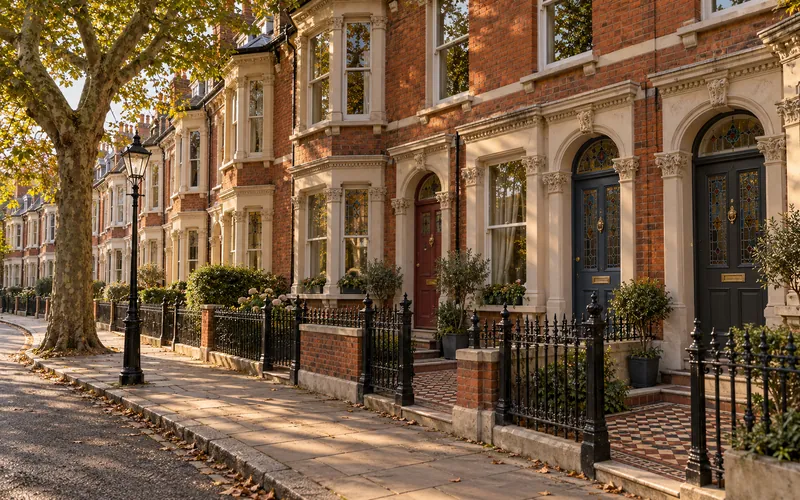
Street of Victorian brick houses with bay windows and painted front doors
The Victorian terrace: brick, bay windows and front doors in Brompton Road or Arts Club.

The society

The workshop of the world

Railways, factories, empire: under Victoria, Britain became the first industrial power and its cities doubled and trebled. A middle class of clerks, shopkeepers and engineers moved into rows of brick terraced houses with a bay window, a basement and a back garden.

The Great Exhibition of 1851, in the Crystal Palace, showed the world what the machine could make; department stores and catalogues put comfort within everyone's reach. For the first time, decorating the home became a mass pursuit.
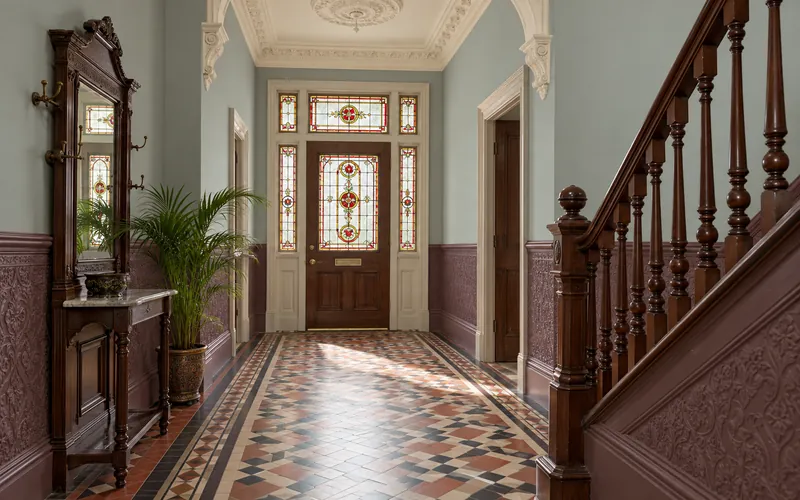
Victorian tiled hallway with smoky green walls and a claret dado
Museum above the dado rail, Rothschild Street on the Lincrusta.

The interior

Tiles, Lincrusta and the bay window

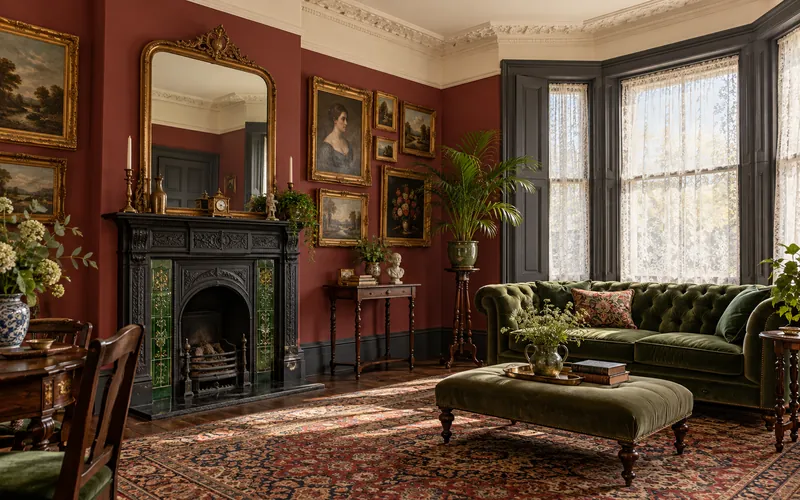
The hall was floored with geometric encaustic tiles; a turned staircase led to the bedrooms, the parlour opened through a bay window and was warmed by a cast-iron fireplace with tiled slips. The wall was divided in three, dado, filling and frieze, by a dado rail and a picture rail.

Lincrusta, the embossed wallcovering invented in 1877, protected the lower walls; fabrics, potted palms and gilt frames filled the rest. By the century's end William Morris and the Arts & Crafts movement were preaching a return to simplicity and plant forms.

Claret Victorian parlour with a cast-iron fireplace, chesterfield and palm
Arts Club on the walls, Lots Road on the ceiling: Victorian depth.

The colours

Chemistry brought colour to everyone

In 1856 William Perkin stumbled on mauveine, the first synthetic dye; dozens of new, stable, cheap pigments followed. Claret, forest green, plum, warm brown, Prussian blue: the Victorian house could at last afford the deep colours the previous century had kept for the rich.

Those tones also hid the soot of gas and coal: darker below the dado, lighter above. Crace honours the decorator J.G. Crace, Museum the South Kensington galleries, Brompton Road their neighbourhood; Sorrel Green and Stockwell Green carry the Arts & Crafts spirit.

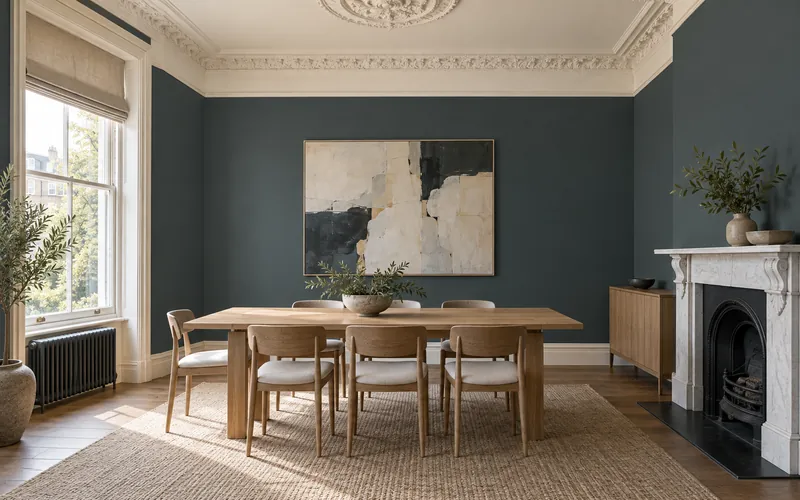
A Victorian dining room today, deep green walls and a cream ceiling
Market Green and Lots Road: Victorian, 2026 edition.

The legacy

And today?

When Victoria died in 1901 the Edwardian age aired the interiors: whites, light greens, Art Nouveau patterns. But millions of Victorian houses still stand, and their fireplaces, tiles and dado rails naturally call for colour.

Paint the dado a deep tone, Rothschild Street, Plum Tree or Market Green, and the wall a softer tone of the same family, with ceiling and cornice in Lots Road. In Marble Matt Emulsion these colours take on the velvety depth Victorian rooms deserve.

25 colours found

Showing 25 to 25 of 25 results

Show
per page
Sign up to our newsletter

Sign up to our newsletter

Thanks for signing up to our newsletter!