


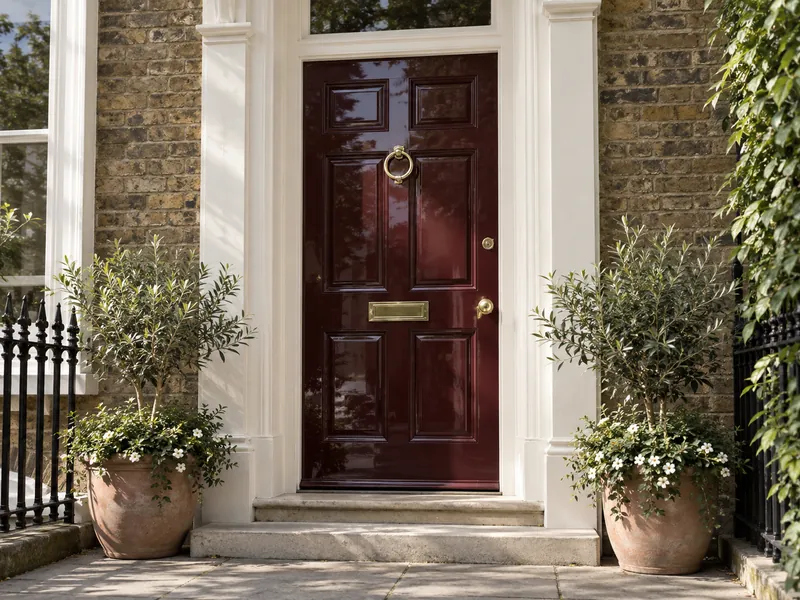
01
Deep burgundy
The classic townhouse door: in Gloss, it is almost black in shade and red in sun. Off-white frame.
Menu
How To
Design Advice
Customer Service
My account
Help with paint Painting outdoors
A front door is painted over two dry days, between 10 and 25 °C, in the shade: hardware removed, wood washed, sanded and filled, primer on bare wood, tinted undercoat, then two coats of Multi-Surface Gloss or Satin — three if the door faces south or west — following the order of the panels. The door stays on its hinges, ajar, and closes in the evening without latching. Allow a 1 L tin for an ordinary door, primer and undercoat included, and a week of care before slamming it.
Page updated September 2026 · by the Mylands France colour team
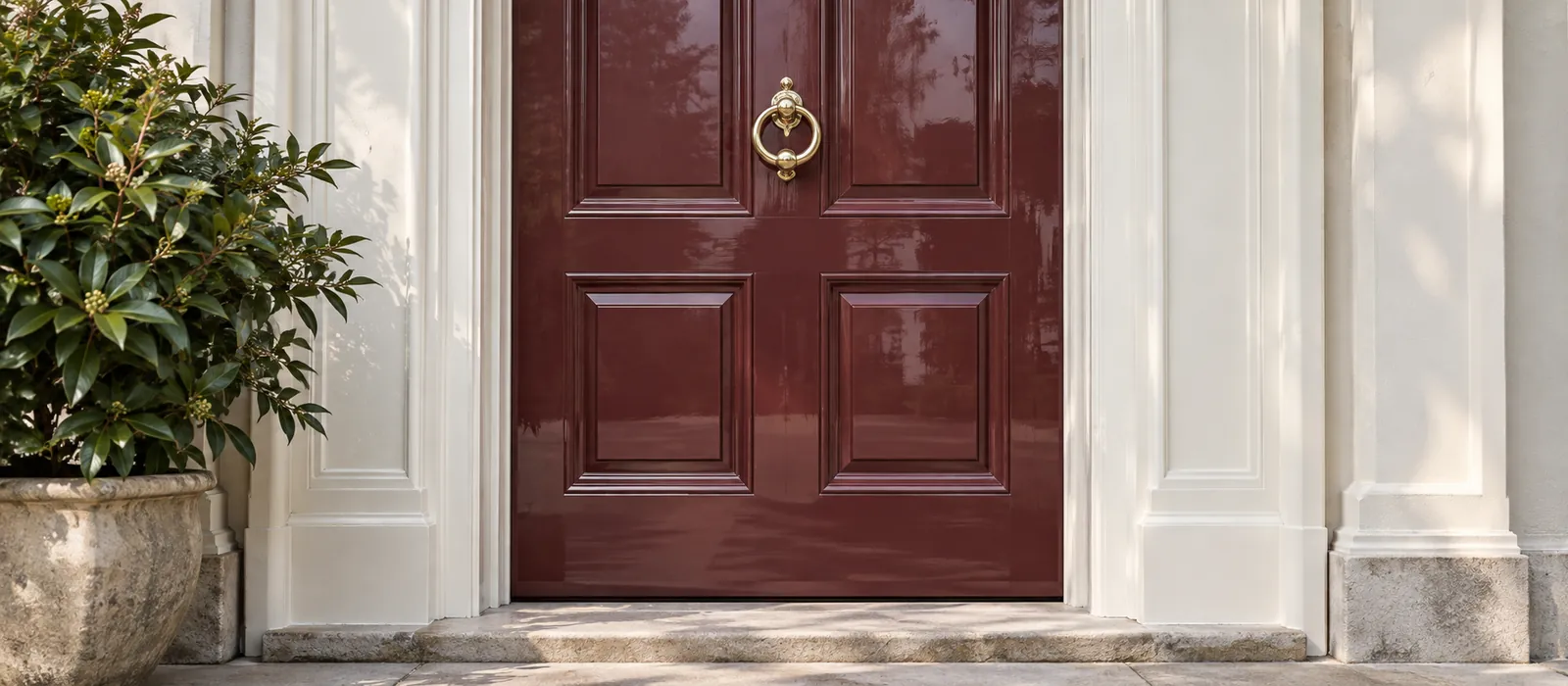
Before
The weather decides. You need two consecutive days without rain, between 10 and 25 °C, and a door in the shade when you paint: in full sun, the paint dries before it has flowed out and keeps the brush marks. A south-facing door is painted in the morning; a north-facing one in the afternoon. No painting after 5 pm in autumn: the evening dew marks a fresh coat.
The finish. Multi-Surface Gloss is the classic finish for a front door: the hardest, the most washable, and the one that gives dark colours their lacquered depth. Satin is more forgiving of an old door's flaws; Eggshell suits a country house door, low-sheen and soft. All three hold outdoors, over primer and undercoat. Choosing the colour: Colours for a front door.
The quantity. A door of 2.1 × 0.9 m is under 2 m² per face: a 1 L tin is enough for two to three coats on the outer face, plus the edge. A 100 ml sample pot to test the colour on the bottom of the door, a week before.
The method
Handle, knocker, letterbox plate, spyhole, number: everything that unscrews goes in a labelled bag. What does not unscrew (lock, hinges) is masked with tape. Painting around a handle always shows.
Sugar soap with a sponge, from the bottom up, then rinse with clean water and dry. A front door is greasy (hands, pollution) and paint does not hold on grease. Leave to dry for two hours.
120 grit over the whole surface to key it; scrape off anything flaking back to sound wood. Probe the bottom of the door and the lower mouldings with the tip of a screwdriver: wood that gives is rotten and gets replaced, not painted.
Exterior wood filler in cracks and redundant screw holes, sanded at 180 once dry, dusted off with a damp cloth. Mouldings are sanded by hand, not by machine.
Multi-Surface Primer on every bared area and on the filler, by brush; on a metal door, over the whole surface after de-rusting. Over sound old paint, primer is not needed. A night's drying.
One coat of Primer & Undercoat tinted to the finish colour over the whole door: it unifies the base and saves a coat of finish on a deep colour. 3 to 4 h drying, a light rub-down at 180.
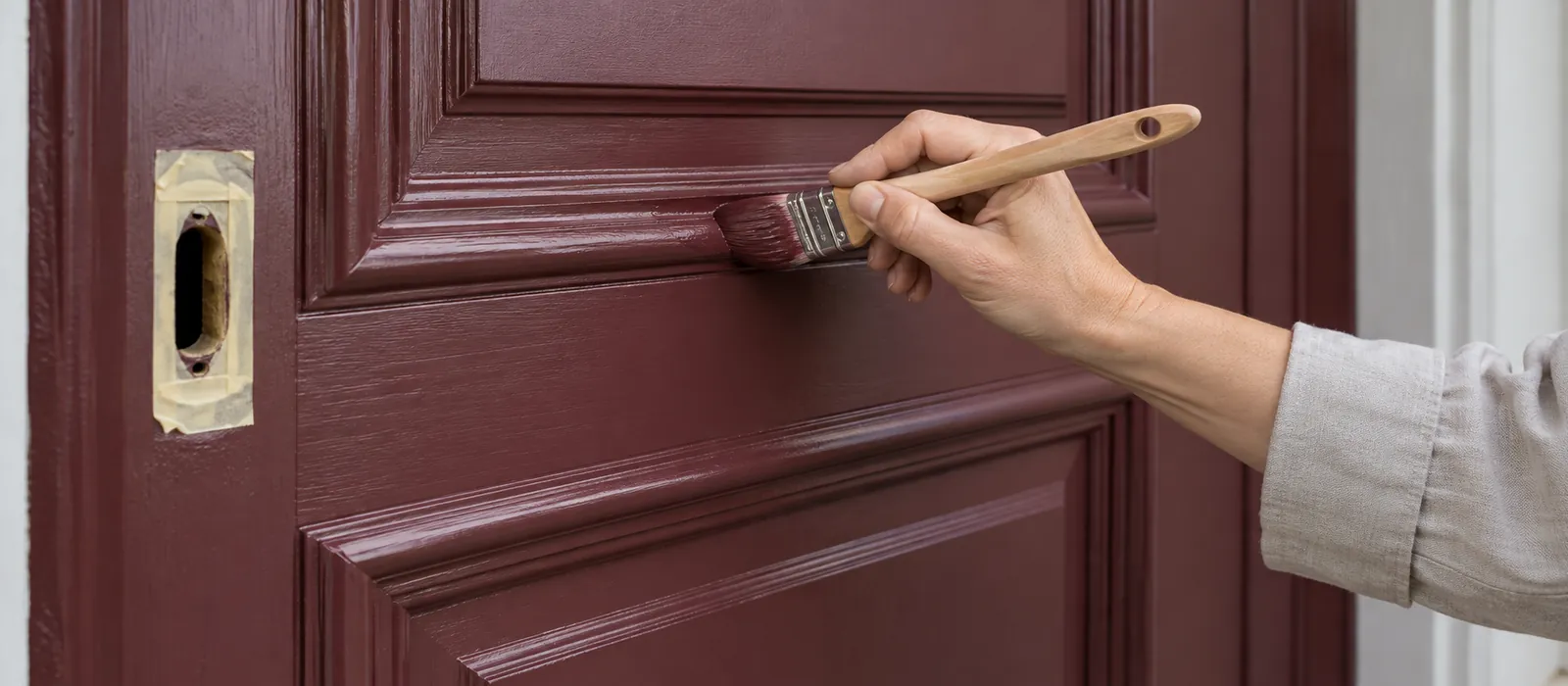
On a panelled door: the mouldings and panels first (cutting-in brush then flat brush), then the horizontal rails, then the vertical stiles, finishing each area along the grain. On a flush door: foam roller, laid off with a brush from top to bottom.
The lock-side edge is painted in the outside colour, the hinge-side edge in the inside colour. The top and bottom of the door, unseen, get a coat too: that is where water gets into the wood.
Recoatable after 3 to 4 h in dry weather; the next morning is safer. Rub down lightly between coats. Three coats if the door faces south or west, or if the colour is deep in Gloss.
Hardware refitted after 24 h; no slamming or cleaning for a week; full cure in two to four weeks. A door wedge for the night of the last coat, a cloth over the strike plate.
By door
| The door | Preparation | Primer | Finish |
|---|---|---|---|
| Painted wood, sound paint | Washing, 120 grit sanding, filling | On bared wood only | Undercoat + 2 coats, 3 facing south |
| Painted wood, flaking paint | Strip the areas coming away, sand, fill | Multi-Surface Primer throughout | Undercoat + 2 to 3 coats |
| Bare new wood | 120 then 180 sanding, dust off; wood under 15% moisture | Multi-Surface Primer, two coats on end grain and knots | Undercoat + 2 to 3 coats |
| Varnished or stained wood | Careful sanding until all the varnish is dulled | Multi-Surface Primer throughout | Undercoat + 2 coats |
| Metal (steel, iron) | De-rust with a wire brush and 120 grit, degrease with alcohol | Multi-Surface Primer; over residual rust, an anti-rust primer first | 2 coats Gloss or Satin |
| Aluminium, uPVC | Degrease, very fine 240 sanding | Multi-Surface Primer, after an adhesion test | 2 coats; light or mid shades only on uPVC (dark ones distort it) |
The wood must be dry through: after a week of rain, wait two dry days before painting. The detail on outdoor timber: Painting outdoor woodwork.
The colours
The door is the one surface of a house where a deep or bright colour fully belongs — provided the frame and the joinery stay calm. Six pairs that work from the street.
01
The classic townhouse door: in Gloss, it is almost black in shade and red in sun. Off-white frame.
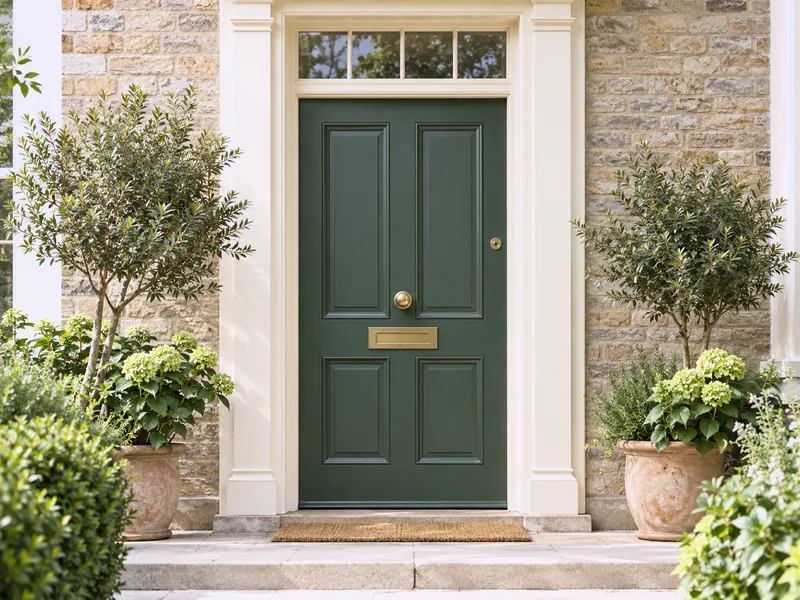
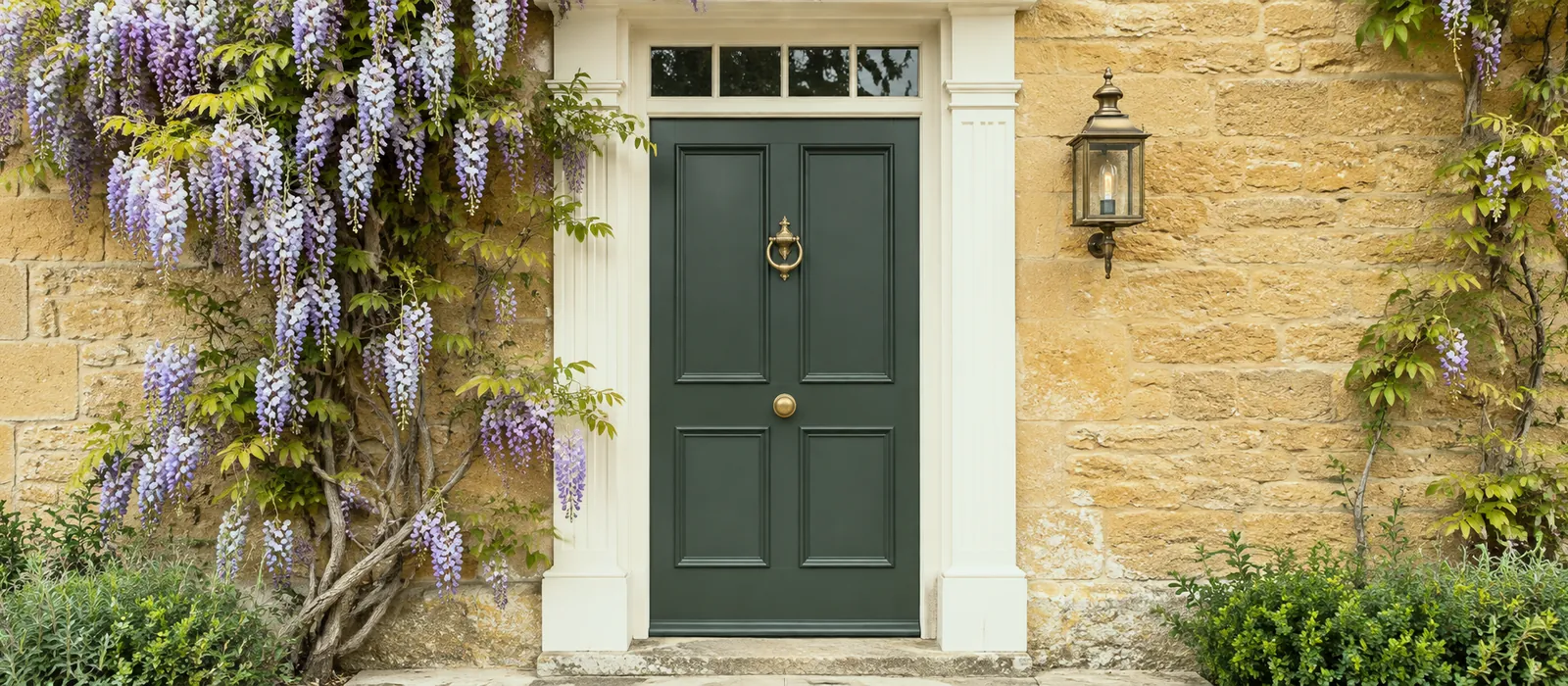
02
On a stone or brick façade, the deep green makes the family house. Joinery in the same green or in stone white.
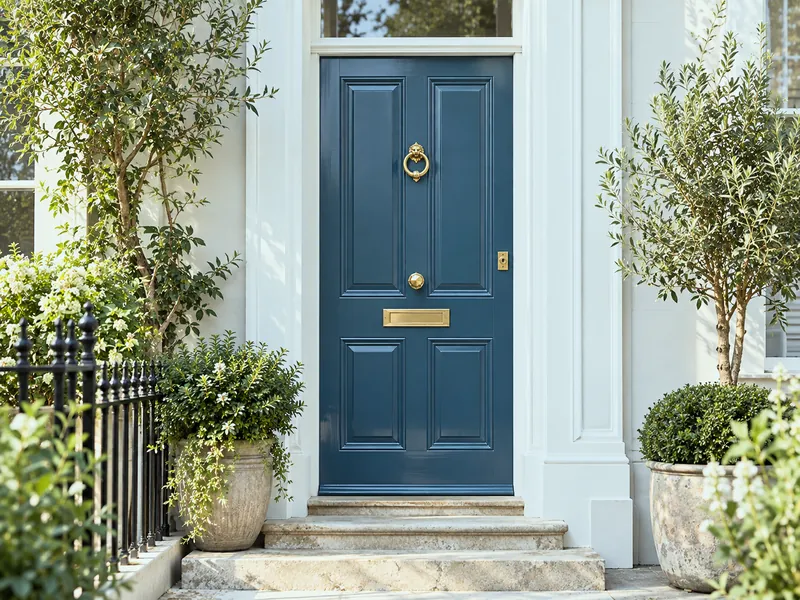
03
The deep blue that goes with slate, zinc and brass. For a townhouse or a seaside house.
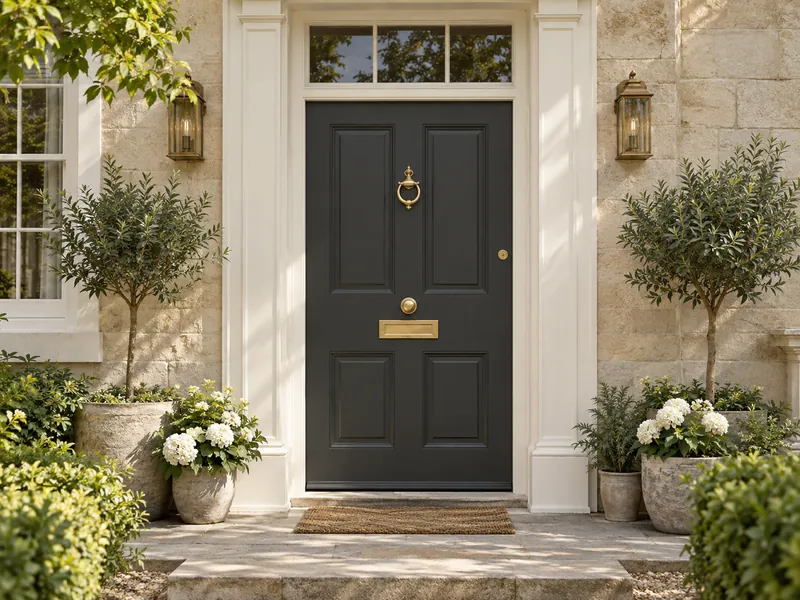
04
The black that is not black: a very deep grey, softer in sun, that brings out the brass. On any façade.
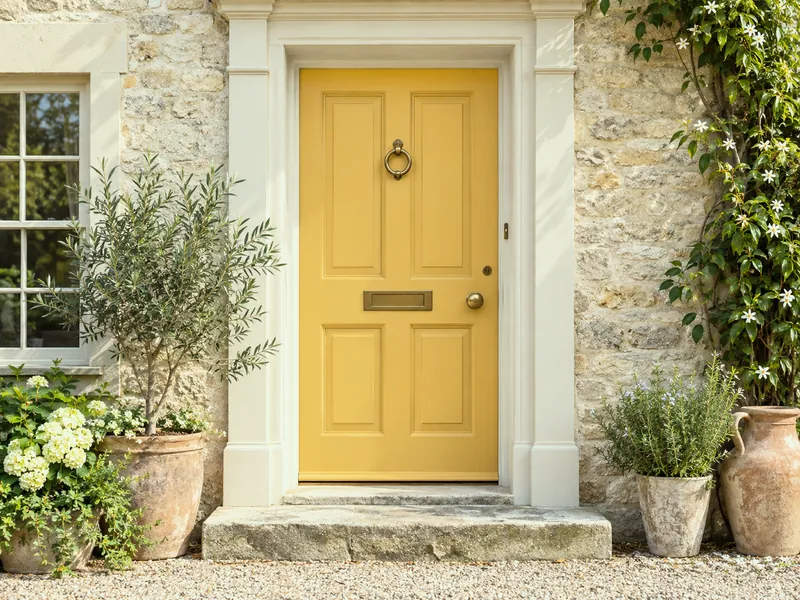
05
The cheerful door of a village house: an ochre yellow, never a lemon yellow, that holds the southern sun.
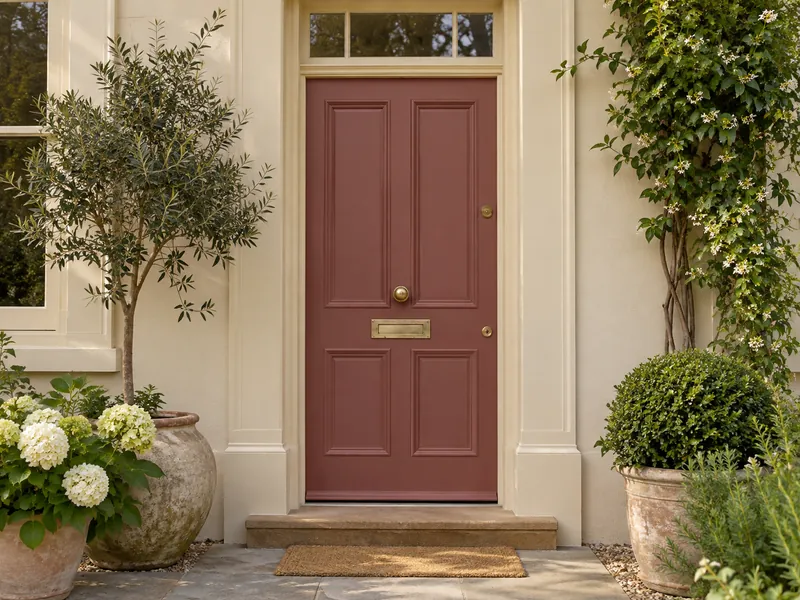
06
A softened brown-pink on a cream render: the door that surprises without shouting. With aged brass.
To avoid
Frequently asked questions
No: on its hinges, ajar and wedged, it paints just as well and closes in the evening. You take it off only to strip it completely, or to roller a flush door flat, which gives the most perfect flow-out.
Touch-dry in 2 to 3 h, it closes without latching the same evening, a wedge or a cloth over the strike plate. No slamming or cleaning for a week; full cure in two to four weeks.
Gloss for the classic door, lacquered, washable, giving dark colours their depth — it demands more careful preparation because it shows everything. Satin for a less-than-perfect old door or a country house. See Which finish for woodwork and doors.
Yes, and it is often better: the outer face in the street's colour, the inner face in the hall's woodwork colour. The lock-side edge follows the outside, the hinge-side edge the inside.
Yes, with Multi-Surface Primer after degreasing and very fine sanding, in a light or mid shade: a dark colour heats uPVC in the sun and can distort it. Test adhesion on a hidden area a week beforehand.
See also
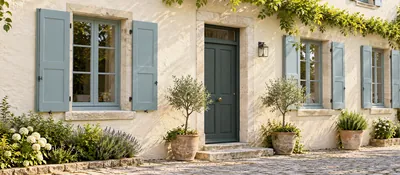 Outdoors, a colour looks twice as light: one shade deeper, composed with the stone and the roof. Six palettes...
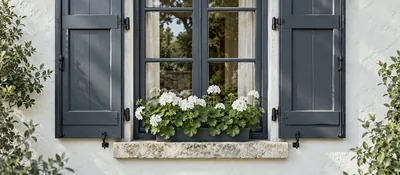 Probe, strip what is coming away, sand, prime, two coats — three facing south. Windows, shutters, gates, eaves...
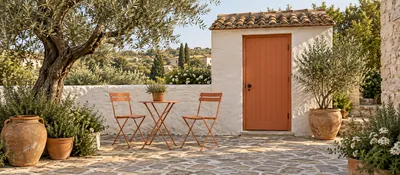 What to paint outdoors and what not to, a three-colour palette tied to the house, one accent. Six weekend proj...
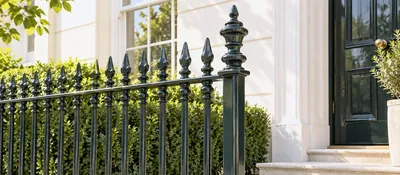 From the radiator to the gate: the finish that holds on steel and cast iron, the preparation, and the colours.
“A front door is painted twice: once for the colour, once for the next ten years.”

Thanks for signing up to our newsletter!
Sign in to save items to your wishlist. Sign in to save your basket, so you can continue shopping later.
Don't have an account? Create one
Share this link and friends can buy items from your list. Anything bought disappears from it automatically. Anyone with this link can see your selection.
Moving in, redecorating, or dropping hints? A free account turns this selection into a gift list — add or remove colours whenever you like, and we'll email you when someone buys something from your shared list.
Free · Delivered to your door
Get a free colour card posted to you, showing our complete Colours of London range, with swatches made from the real paint for a true representation of our award-winning colours.

