
The journal
Ceiling paint: white, tinted or drenched, how to choose
The right ceiling paint is a very matt finish that hides flaws and throws back no reflection: our Ceiling Paint, formulated for the purpose, or Marble Matt Emulsion as soon as you want a colour. What remains is choosing between pure white, the wall white, a paler shade or a complete colour drench.
A ceiling is painted last and forgotten at once, which is exactly the point. Ceiling paint has a single job: to disappear, which means throwing back no reflection, betraying no join or bump, and letting the light get on with its work. Yet it is the most unforgiving surface in the house, lit at a raking angle by the windows, peppered with plaster repairs and painted at arm's length. This guide answers the three questions people ask before buying: which finish, which colour, and how to apply it without leaving marks.
Ceiling paint or Marble Matt Emulsion: two answers to one question
Mylands offers two products for a ceiling, and the choice comes down to one thing: whether or not you want a colour. Ceiling Paint is a formula developed specifically for this purpose. Its finish is flat, without the slightest sheen, and it is this complete absence of gloss that evens out the surface: repairs, plasterboard joints and the gentle undulations of an old ceiling melt into diffused light. It is the simplest answer when what you want is a white ceiling, clean and uneventful.
As soon as you want a tint, Marble Matt Emulsion takes over. It is our signature wall paint, very matt as well, and it comes in every colour on the card. It contains crushed Carrara marble, which gives a denser film and a mineral touch, and it covers around 15 m² per litre per coat. It is washable, rated class 1 in the EN 13300 wet-scrub test, which matters little on a bedroom ceiling but a great deal above a hob or a bath. Its breathable film also suits old plaster or lime ceilings, which need to release moisture.
In both cases the paint is water-based, low in VOCs and low odour, and tools rinse clean in water. Allow two coats. Marble Matt Emulsion is touch-dry in one to two hours and can be recoated after three to four, which means a ceiling can be finished in a day.

Pure white, the wall white or a colour: what goes on the ceiling?
The reflex for a shiny white ceiling is a hangover from cheap paints that came in no other shade. Today the question deserves to be asked room by room, and there are three ways to answer it.
The same white as the walls
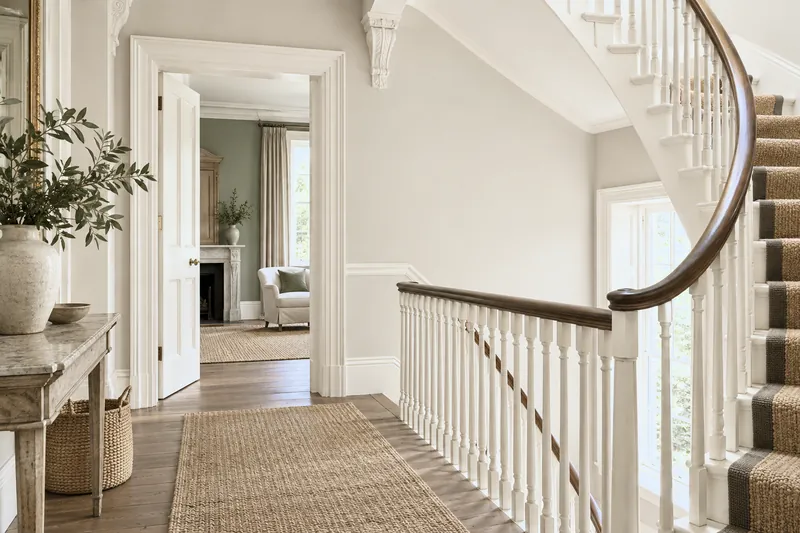
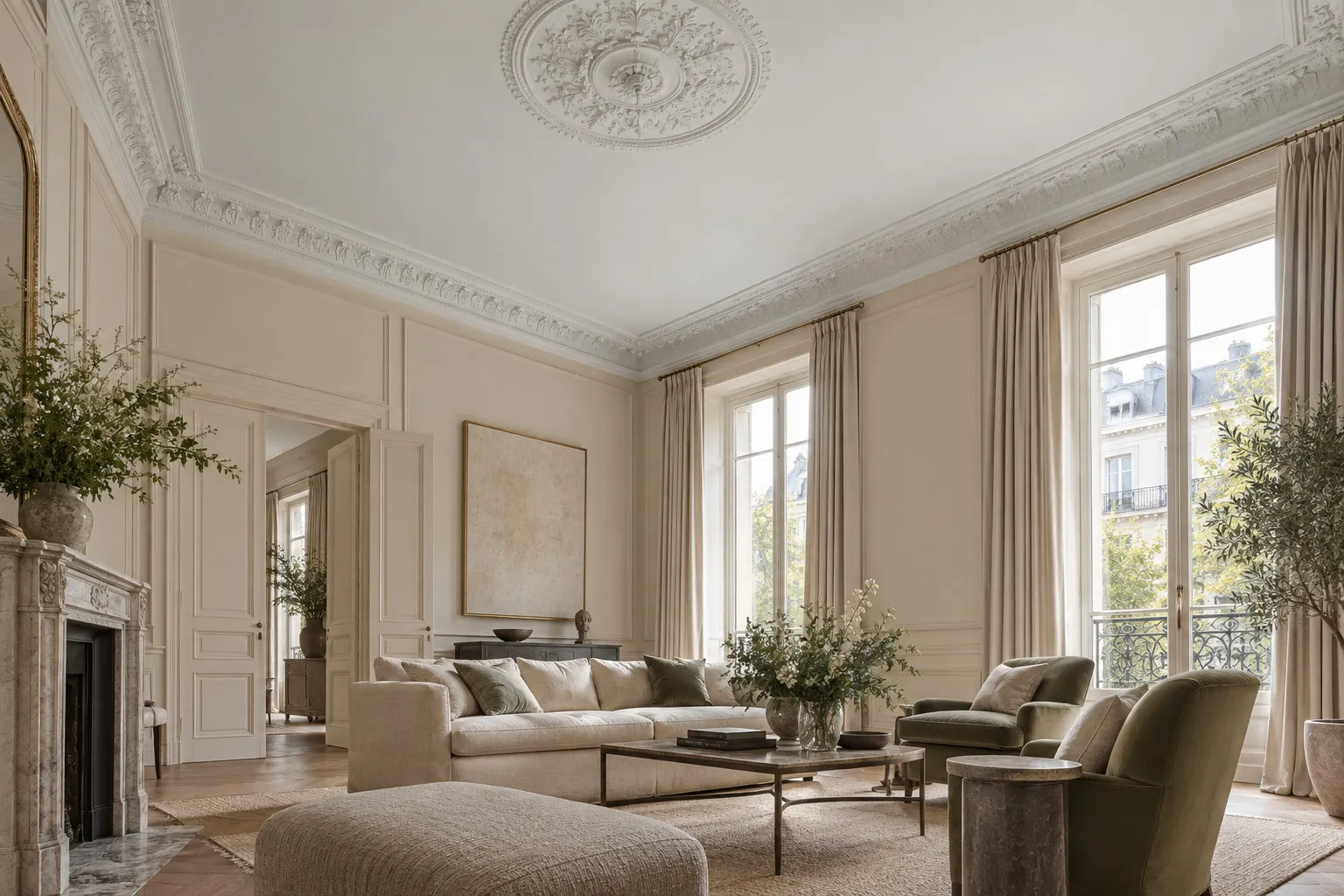
If your walls are painted in a warm white such as Holland Park No.5, a ceiling in Pure White No.1 will look bluish and cold by contrast, and above all it will draw a sharp line that visually lowers the room. Painting the ceiling in the same white as the walls erases that line: the eye slides on without stopping, the room feels taller, and the wall colour looks more like itself. It is the solution we recommend most often for living spaces.
A paler version of the wall colour
When the walls carry a real colour, a ceiling in a neighbouring but lighter tone keeps the harmony without darkening. Above a wall in Cadogan Stone No.59, a warm and subtle stone, a ceiling in Sloane Square No.92, an off-white with a faint grey cast, gives a soft whole with no break. In a bedroom with walls in Pediment No.73, a warm neutral blush, Threadneedle No.262 on the ceiling, barely tinted with orange and umber, carries the colour upwards while keeping the light.
Colour drenching
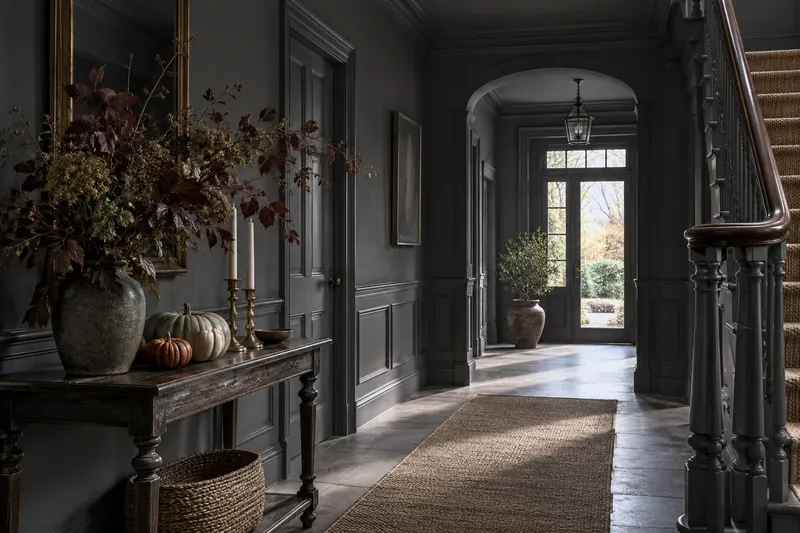
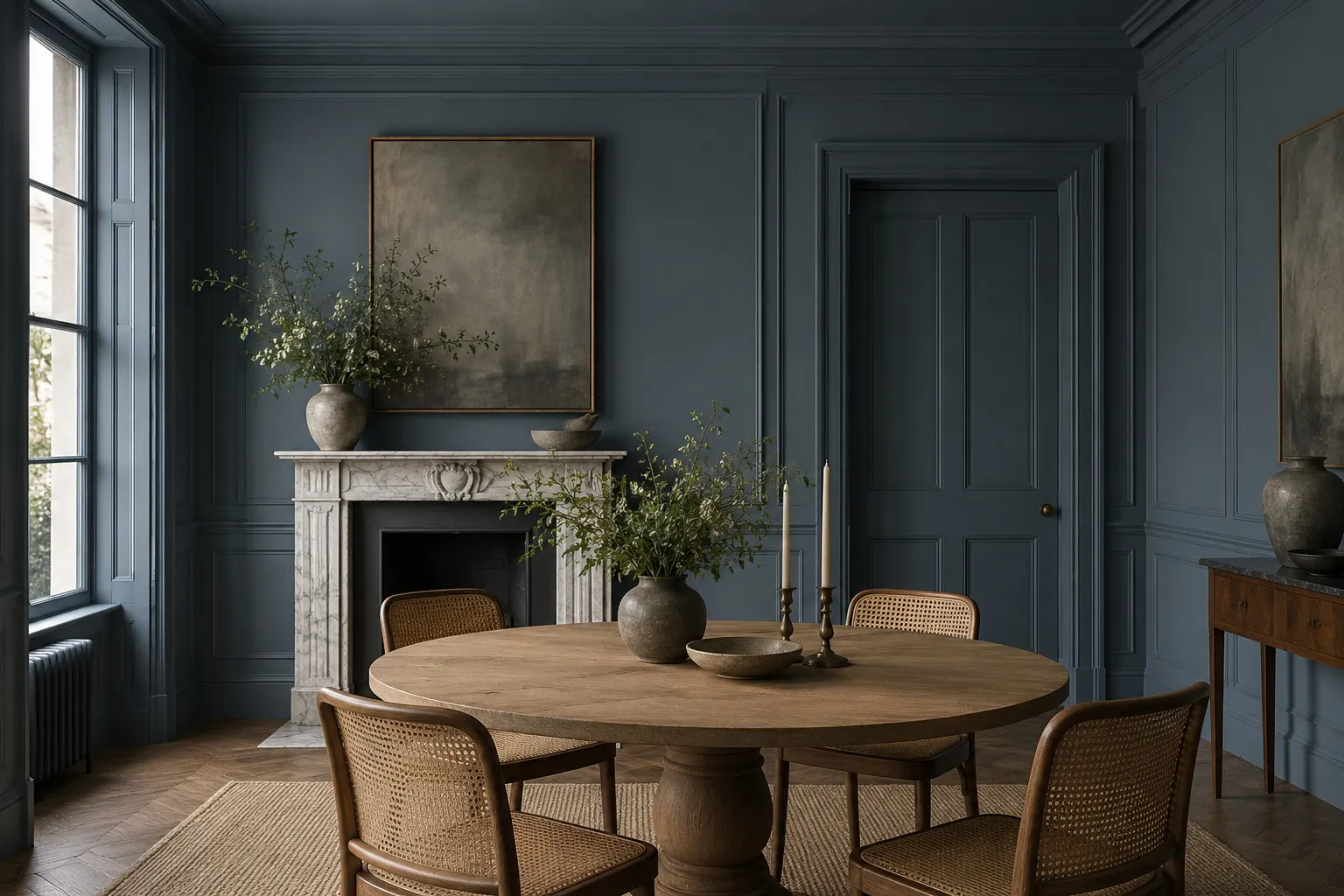
The third route is to paint walls, ceiling and woodwork in a single shade. This colour drenching works remarkably well in evening rooms, a dining room or a bedroom, where what you want is envelopment rather than brightness. A slate blue such as Maritime No.236, or a smoky green such as Museum No.151, takes on a depth overhead that the wall alone cannot offer. The Multi-Surface Dead Matt finish, which goes onto plaster as happily as onto wood and metal, lets you paint everything from one tin.


Low ceilings, dark rooms: what the ceiling colour can do
You read everywhere that a white ceiling makes a low room feel bigger. It is half true. White bounces back more light, but the dividing line between a coloured wall and a white ceiling pulls the eye to exactly the spot where you would rather it did not stop. In a low-ceilinged room, two strategies work: the same pale tone everywhere, walls and ceiling, to erase the boundary; or a shade just slightly lighter on the ceiling, taken from the same family. A pale blue such as Hawksmoor No.112 on the ceiling of an off-white room, for instance, suggests a sky without digging a trench.
The finish matters as much as the shade. A satin ceiling reveals every irregularity, because raking light from the windows catches the relief. A deep matt, on the contrary, absorbs it. That is why we advise against any sheen on a ceiling: in a dark room the answer is not a reflection but a pale, matt shade that diffuses the light instead of concentrating it.
A successful ceiling is one nobody ever mentions, because the whole room simply looks right.
Painting a ceiling without roller marks
Marks on a ceiling almost always have the same cause: going back over an area that has already started to dry, or a direction of travel that changes halfway through. A few rules are enough to avoid them.
- Prepare the surface: dust, fill, sand the repairs, then apply a primer on a new, porous or freshly repaired ceiling. Allow around 0.5 L of primer for every 1 L of paint on these surfaces.
- Paint the ceiling before the walls, and cut in the edges first with a brush along a band a few centimetres wide, never getting more than a metre or two ahead.
- Always work in the direction of the main light, from the window towards the back of the room, in parallel bands that overlap while the previous band is still wet.
- Load the roller evenly and never go back over an area that is starting to pull: wait for the second coat.
- Apply the second coat after the recoat time, crossing the direction of the first pass slightly if the ceiling is very brightly lit.
For quantities, measure length times width and divide by the coverage of your chosen finish, then multiply by two coats. The paint calculator does the sum for you, primer included.
Where to start
A ceiling is tested like a wall, except that you have to look up. Paint a 100 ml sample onto a piece of card and hold it against the ceiling in the morning and again at the end of the day: an off-white can slip towards grey as soon as the light drops. Sample pots cover around 1.5 m² and allow two or three trials; the physical colour card is sent free of charge. The price per square metre of each finish is set out on the paint prices page. For a white ceiling, simply order Ceiling Paint; for a tinted one, ask for a sample of the wall colour and of the next shade lighter, and compare the two on the ceiling itself.
Frequently asked questions
Which paint for a ceiling: matt or satin?
Always matt, and the flattest you can find. Light from the windows strikes a ceiling at a raking angle and reveals every irregularity the moment the surface has any sheen. Our Ceiling Paint, with its flat finish, is designed for a flawless white ceiling; Marble Matt Emulsion, very matt and washable, is the one to use as soon as you want a colour, including in kitchens and bathrooms.
Should the ceiling be painted the same colour as the walls?
Very often, yes. In a room with off-white or pale neutral walls, the same tone on the ceiling erases the dividing line and makes the room feel taller. With more strongly coloured walls, you can choose a lighter version of the same shade, or paint everything in the wall colour for an enveloping effect, particularly in a bedroom or a dining room.
How do you paint a ceiling without leaving marks?
Cut in the edges with a brush just before rolling, without getting too far ahead, then work in parallel bands in the direction of the light, from the window towards the back of the room. Each band should overlap the previous one while it is still wet. Never go back over an area that has started to dry, apply two coats, and choose a very matt finish, which hides the overlaps.
Which ceiling colour for a low room?
A pale, matt shade, ideally the same as the walls. It is not white in itself that lifts a ceiling, it is the absence of a break line between wall and ceiling. If the walls are coloured, pick a paler version from the same family for the ceiling rather than a pure white, which would carve up the room and draw the eye to the very height it lacks.