

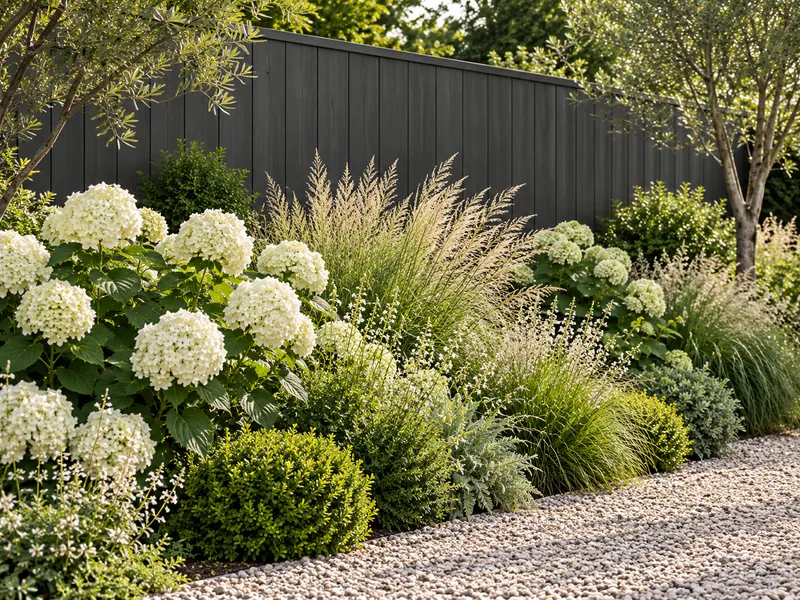
01
Black-grey: the backdrop
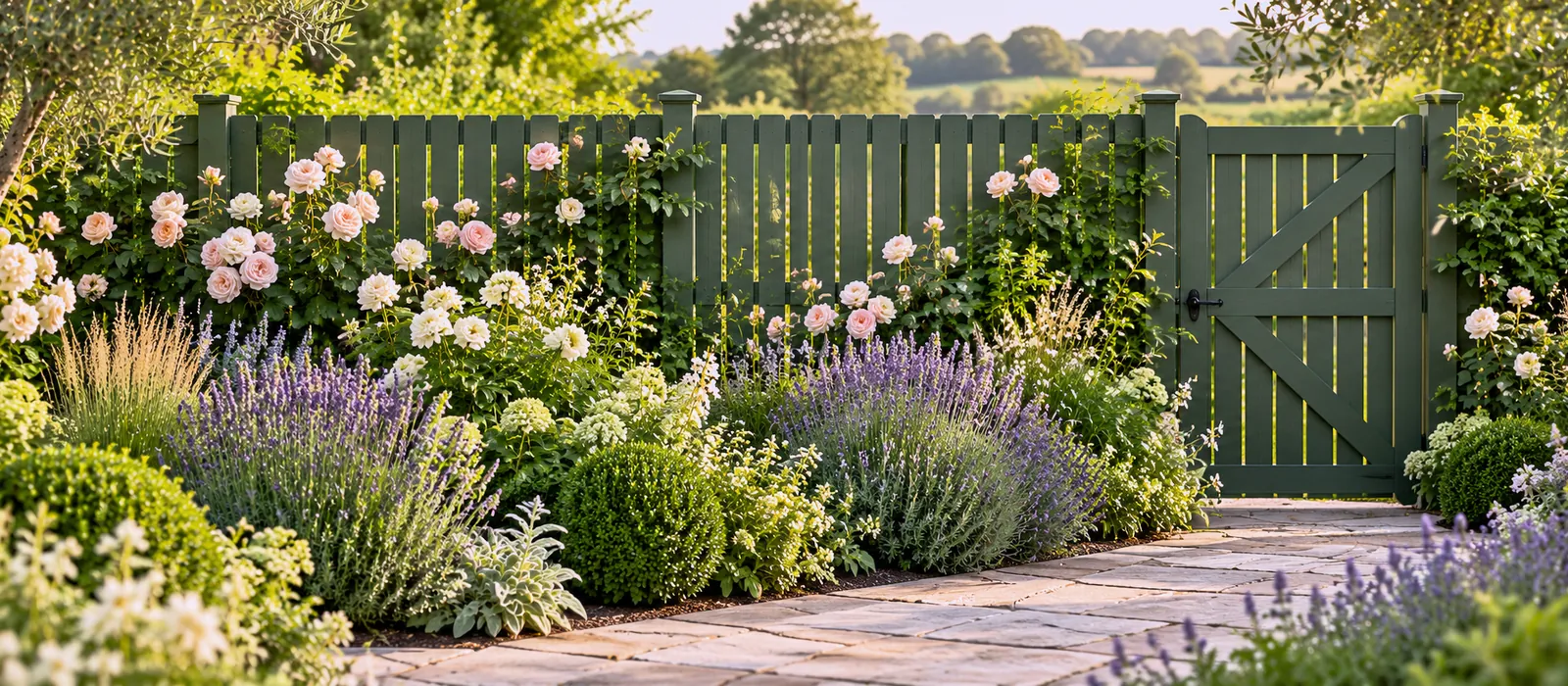
The fence disappears, the plants come forward, the garden grows. The choice of contemporary gardens and gardens of grasses.
Menu
How To
Design Advice
Customer Service
My account
Help with paint Painting outdoors
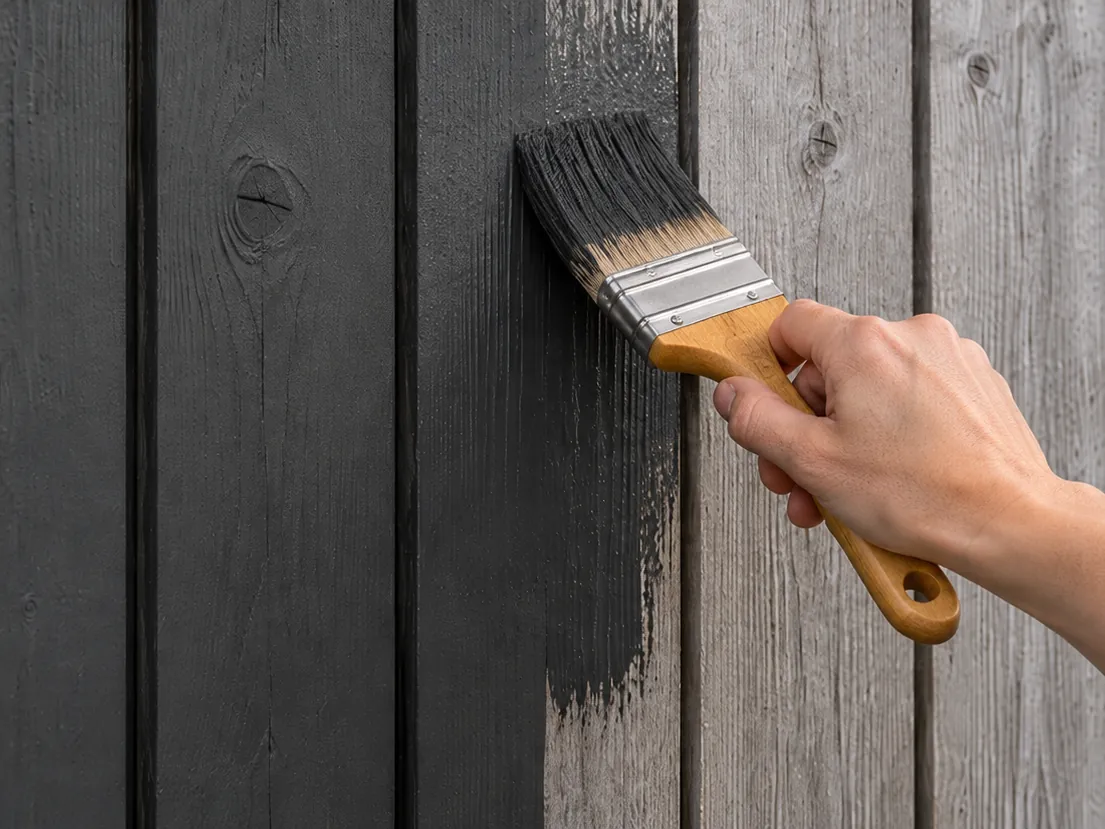
A wooden fence is painted by brush, in dry weather, on dry, brushed-down wood: Multi-Surface Primer on the bare wood and above all on the end grain, then two coats of Multi-Surface Eggshell, on both faces, the posts and the tops of the panels. A new pressure-treated fence waits four to six weeks before being painted. The choice that changes everything is the colour: a dark fence — deep green, grey-black, brown — recedes, brings the plants forward and makes the garden bigger; a light fence closes it in. Allow the coverage of rough timber, 10 m²/L, and both faces.
Page updated September 2026 · by the Mylands France colour team
Understanding
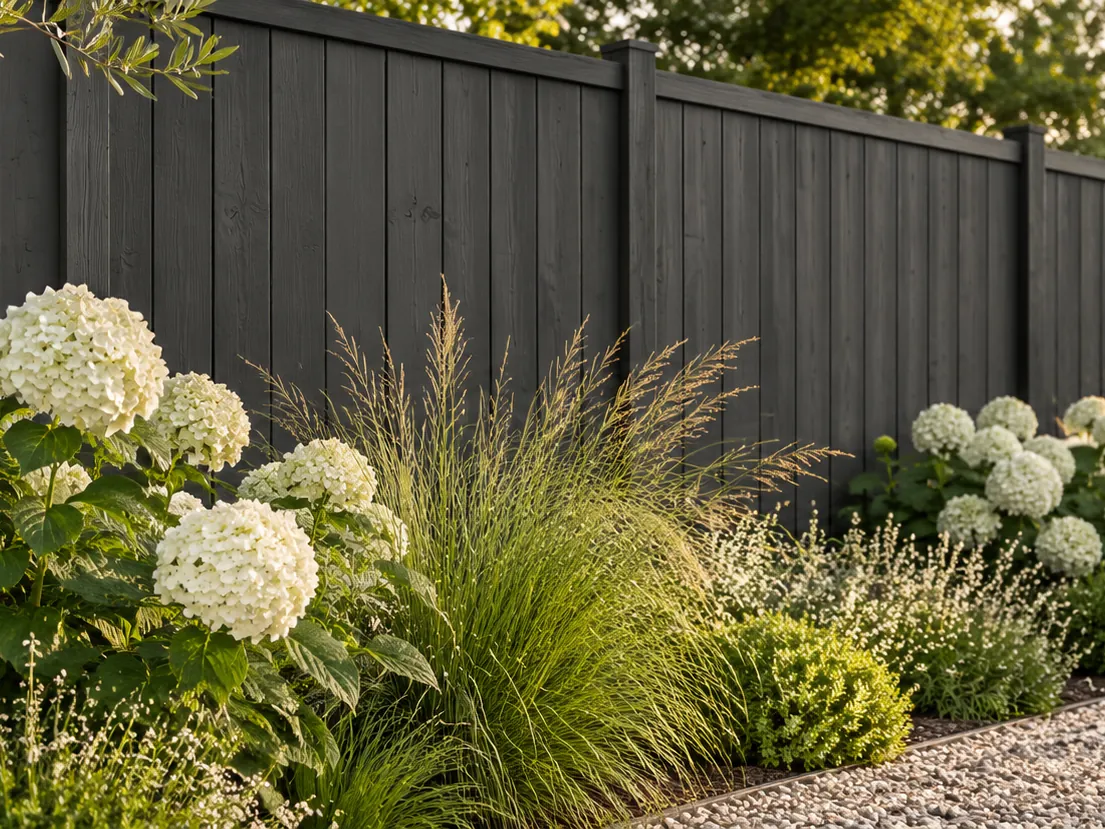
A fence is the back of the picture: what is in front of it — plants, furniture, lawn — is read by contrast with it. A light fence (new wood, white, pale grey) draws the eye to itself and marks the boundary; a dark fence — deep green, grey-black, brown — merges with the shade, recedes, and the foliage stands out against it as against a stage backdrop. The garden looks bigger because its boundary disappears. It is the same rule as the dark wall at the end of a corridor, in Make a room look larger with paint, but in reverse: here it is the background that has to step back.
Paint protects too: fence timber, thin, set in the ground, exposed on two faces, greys in a year and splits in five. Multi-Surface Eggshell, low-sheen and flexible, formulated for exterior use over primer, protects it for up to ten years with a maintenance coat roughly every three years. What it does not protect: the buried part of the posts, which is a matter of timber treatment and metal post shoes, and the top of a flat panel where water stands, which gets a capping or a sloped rail.
The method
New pressure-treated fence: four to six weeks outdoors, until the damp green has faded and a drop of water soaks in instead of beading. Old fence: two days of dry weather. Wood painted damp blisters at the first warm spell.
Cut back or tie back plants to 50 cm; dust sheet on the ground on both sides, tape on the gate's hinges and lock, cardboard against the neighbour's wall. Warn the neighbour: the face on their side gets painted too, and that is half the job.
Stiff brush over the whole fence to remove dust, dry moss and lifting fibres; fungicidal wash on green areas, left to work, brushed, rinsed; scraper on any old paint that is flaking. No pressure washer on thin boards. Two days' drying if you rinsed.
Split or rotten boards replaced; proud screws driven in; exterior wood filler in the splits of the posts; a light sanding at 120 on rough boards, along the grain.
Multi-Surface Primer on all bare wood, two coats on the tops of boards and posts, the bottoms of boards and every cut: the end grain is where water gets in. Over sound old paint, primer is not needed. A night's drying.
Wide brush along the boards, top to bottom; cutting-in brush between the boards and in the corners of the posts. On a smooth panel, a long-pile roller followed by the brush. The brush works the paint into the wood where a sprayer lays it on top. Both faces, the posts, the top.
The next morning, same method. The gate comes off its hinges and is painted flat on trestles if possible, every face and edge, like a shutter. Tape removed as soon as touch-dry; plants put back after a week.
By fence
| The fence | Weak point | Tool | Worth knowing |
|---|---|---|---|
| Closeboard panels, butted boards | Tops of boards, bottom touching the ground | Wide brush, long-pile roller then brush | A capping or sloped rail on top; 5 cm between the bottom of the boards and the soil |
| Open slats, picket, chestnut paling | Edges of every board | 40 mm flat brush | Long but simple: one edge, one face, the other edge, the other face |
| Posts | End grain at the top, base at the ground | Brush | Two coats of primer on the top; a post cap; the buried part cannot be painted |
| Wooden gate | Joints, bottoms of stiles | Brush, flat on trestles | Off its hinges; hardware removed; every face and edge |
| Rigid mesh, iron railings | Rust at the welds | Round brush, painting mitt | De-rust, degrease, Multi-Surface Primer, two coats of Satin — see Best paint for metal surfaces |
| Composite or PVC fence | Adhesion | Foam roller | Degrease, sand very fine, Multi-Surface Primer after a test; light or mid shades only |
A shared boundary fence is painted on both sides with the neighbour's agreement; the colour of their face is as much theirs as yours — a good conversation to have, and often a shared fence in a single colour.
The colours
Outdoors, a colour looks lighter: these shades are chosen one step deeper. The darks recede and make the backdrop; the mids fade away; the lights close in — keep them for small town gardens you want bright.
01
The fence disappears, the plants come forward, the garden grows. The choice of contemporary gardens and gardens of grasses.
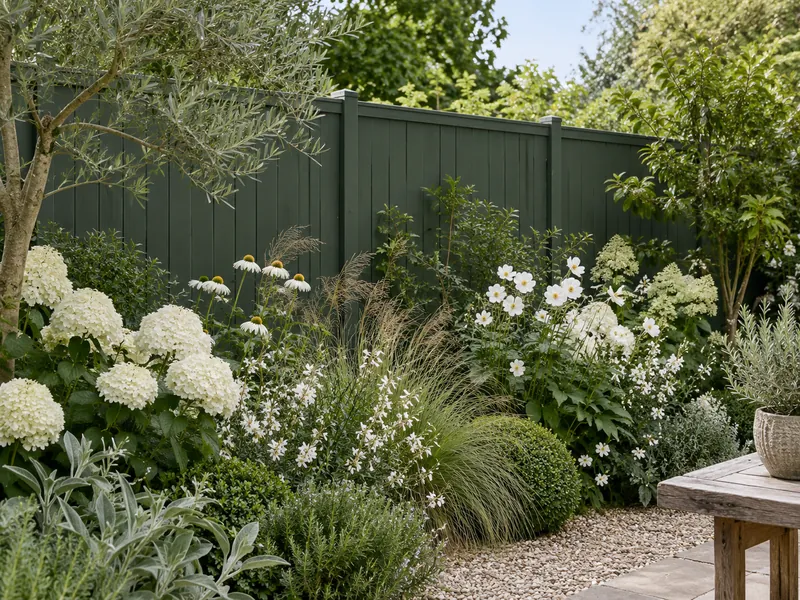
02
The fence reads as a dark hedge; the flowers stand out against it. The most natural of the darks.
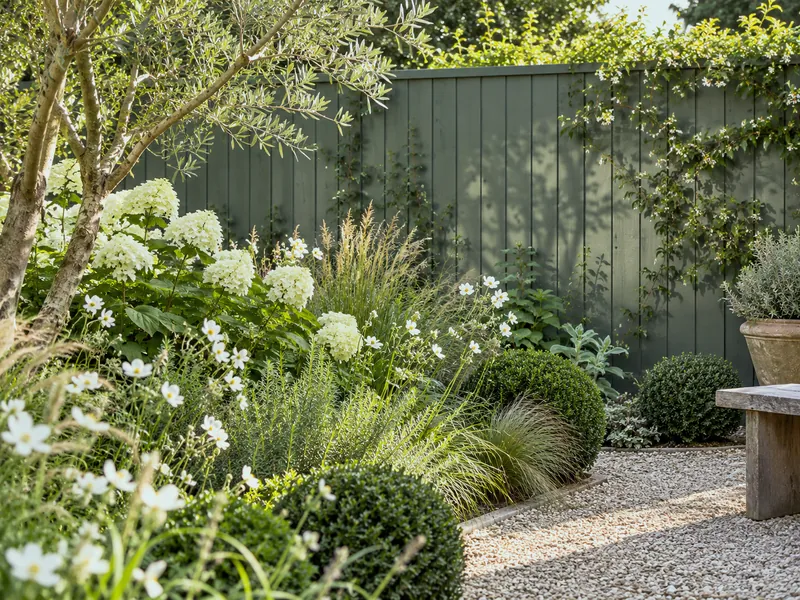
03
The colour of trunks and shade; neither dark nor light, it disappears without darkening. For a country garden.
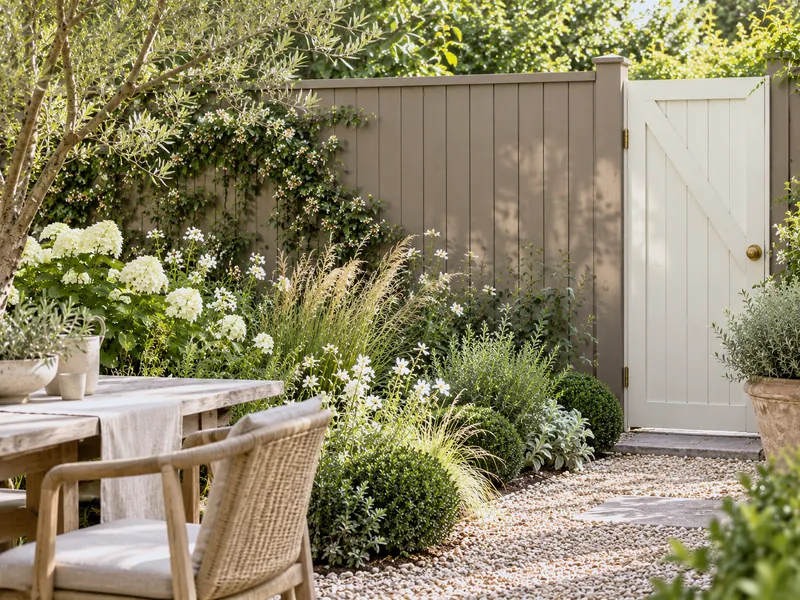
04
A brown-grey that keeps the spirit of the wood without the dirty grey or the orange of stains. With a lighter gate.
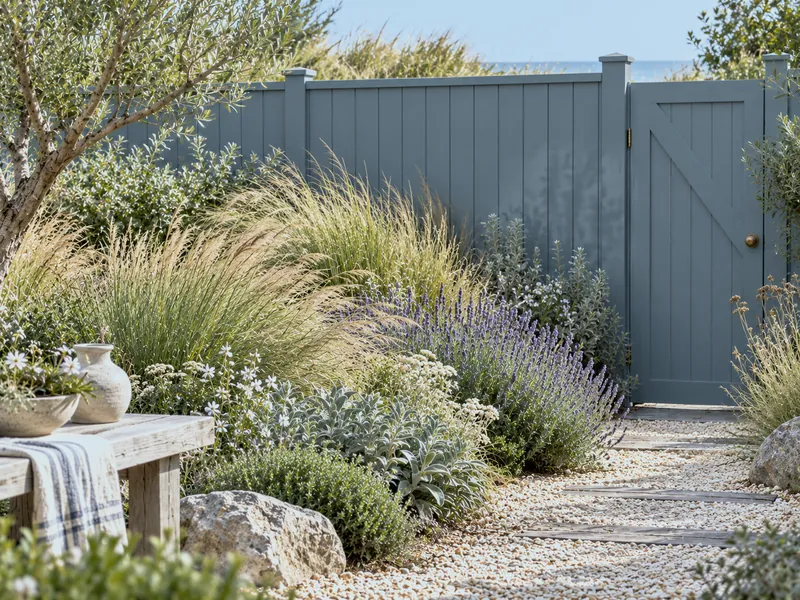
05
A muted blue, almost grey, with grasses and lavender: the dune garden.
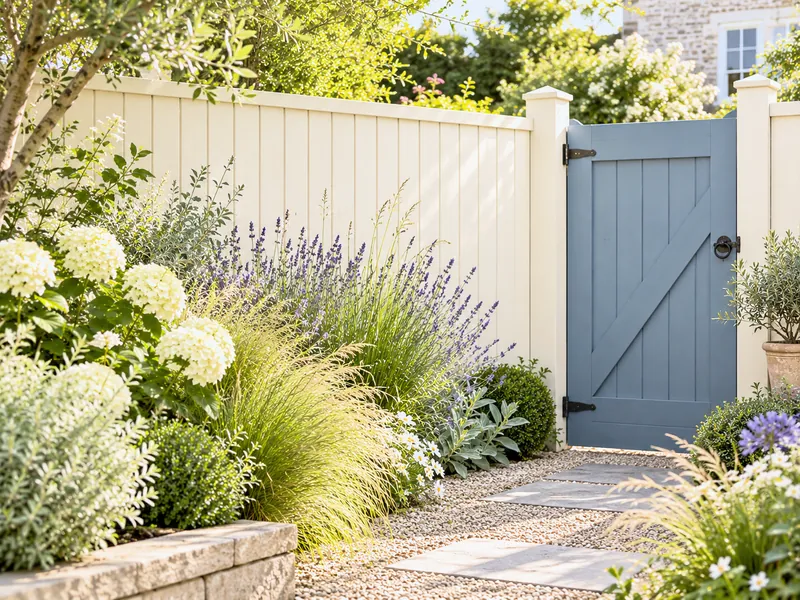
06
For a small town garden you want bright: a warm off-white, never a pure white, with a coloured gate.
To avoid
Frequently asked questions
Length × height × 2 faces, and a coverage of 10 m²/L on rough wood that drinks. A fence 10 m long and 1.8 m high is 36 m²: about 3.5 L per coat, 7 L for two coats — two 5 L tins, or one 5 L and one 2.5 L. The calculator helps you adjust.
Paint (Eggshell over primer) gives an opaque colour and lasts up to ten years with upkeep; stain lets the wood show through and is redone every two to four years; a saturating oil nourishes and greys. For a fence you want dark and acting as a backdrop, paint.
Yes, to save time on a long slatted fence, provided you go over it with a brush afterwards to work the paint into the wood, sheet up generously and pick a windless day — the mist travels. Coverage is poorer and both faces are still needed.
The face on their side is as much theirs as yours: talk about it first. The simplest, and the best-looking, is a single colour on both sides; otherwise each their own face, and the top in the darker colour.
A maintenance coat roughly every three years on the most exposed face, after brushing down; a touch-up as soon as a board greys or a flake appears. The tops of the boards and posts are what you watch.
See also
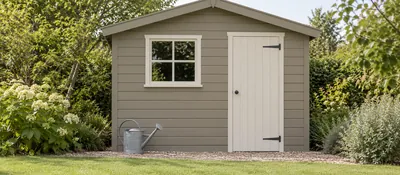 Dry wood, washing, sanding, primer, two coats — three on the exposed face. Six colours to make a shed vanish i...
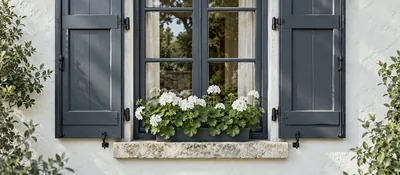 Probe, strip what is coming away, sand, prime, two coats — three facing south. Windows, shutters, gates, eaves...
 What to paint outdoors and what not to, a three-colour palette tied to the house, one accent. Six weekend proj...
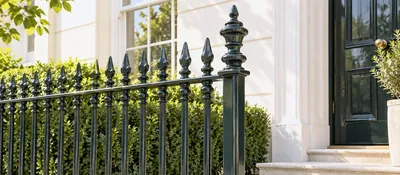 From the radiator to the gate: the finish that holds on steel and cast iron, the preparation, and the colours.
“A dark fence is not a boundary: it is the ground the garden is drawn on.”

Thanks for signing up to our newsletter!
Sign in to save items to your wishlist. Sign in to save your basket, so you can continue shopping later.
Don't have an account? Create one
Share this link and friends can buy items from your list. Anything bought disappears from it automatically. Anyone with this link can see your selection.
Moving in, redecorating, or dropping hints? A free account turns this selection into a gift list — add or remove colours whenever you like, and we'll email you when someone buys something from your shared list.
Free · Delivered to your door
Get a free colour card posted to you, showing our complete Colours of London range, with swatches made from the real paint for a true representation of our award-winning colours.