


Help with woodcare Wood outdoors

Shed, gate, barn: natural wood outdoors

A shed, a gate or a barn door you want to keep as wood is protected with hard wax oil: Hard Wax Oil, in two thin coats 24 hours apart, on dry timber, on a mild dry day. The Burnt Earth, Wenge or Castanea tints even up greyed timber; Natural keeps the colour of new oak. Danish Oil suits a pergola or a bench when you prefer an open-grain look. Allow 6 to 8 hours to touch-dry, 24 hours before handling and 7 to 10 days to cure.

Page updated September 2026 · by the Mylands France woodcare specialists

Why a hard wax oil

What wood outdoors asks for

A shed, a gate, a barn take everything: the sun that greys, the rain that swells the fibres, the shade that holds the damp. Paint answers with an opaque film — that is the subject of How to paint a garden shed. When you want to keep the wood visible, the answer is an oil that penetrates and a wax that hardens on the surface: that is Hard Wax Oil, whose data sheet lists, beyond floors and furniture, outdoor wooden furniture, sheds and barns.

Three qualities matter outdoors: it is UV resistant and spill proof; its thin coats do not peel; it refreshes without stripping, with a thin coat when the wood dulls.

Only two other products go outdoors with it: Danish Oil, for a more open look on a bench or a pergola, and Durax Teak Oil, for oily hardwoods — see Oiling teak garden furniture. The rest of the range is for interiors.

The method

Oiling a shed or a gate in six moves

The floor method, adapted to the outdoors: dry timber, a mild day, two thin coats. The moves in detail: How to oil a wooden floor.

  1. 01

    Choose the day

    A mild, dry day, no rain forecast for the 24 hours that follow, no direct sun on the face being oiled: oils do not dry in the cold, and a hot board drinks the product before it is spread. The timber must be dry, below 18% moisture.

  2. 02

    Clean and let it dry

    Stiff brush and clean water to remove dust, moss and the grey surface layer; rinse, let it dry right through, several days after rain. Any old film of stain or paint must come off entirely: hard wax oil only penetrates bare wood.

  3. 03

    Sand to 120 to 150 grit, never finer

    Through the grits if the timber is rough, finishing at 120 or 150: finer burnishes the fibres and blocks penetration. On a gate, pay attention to the edges and ends, which drink the most. Vacuum, then tack cloth.

  4. 04

    First thin coat, along the grain

    Stir the tin thoroughly. Floor brush or wide brush, in a thin even coat, board by board to keep a wet edge. On greyed timber a tint — Burnt Earth, Wenge, Castanea — evens up better than Natural. Remove any excess at once with a cloth: whatever stays on the surface goes sticky.

  5. 05

    Twenty-four hours, then the second coat, more sparingly

    Touch-dry in 6 to 8 hours, recoatable after 24 hours. A light de-nib with 240 grit if the grain has raised, then a second, lighter coat. On the exposed faces — the top of a gate, a south-facing door — a third coat, 24 hours later, increases durability further.

  6. 06

    Let it harden, then keep an eye on it

    No heavy handling for 24 hours; full cure in 7 to 10 days. Afterwards, as soon as the surface dulls or drinks water, a thin coat on clean dry timber. Oily cloths go in a bucket of water or are laid flat outside to dry: bundled, they can catch fire on their own.

Four cases

The right product for each piece

01

The new oak gate

A barred oak gate, still honey-coloured, between two stone piers. Hard Wax Oil Natural keeps that colour and protects it from splashes; two thin coats, a third on the top rail and on every bar end, which drink the most. The wood stays visible, the grain readable.
02

The greyed garden shed

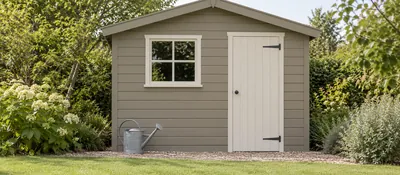
A shed in spruce boards that has gone five winters with nothing: silver-grey on the south side, greenish on the north. After brushing and sanding with 120, Hard Wax Oil Burnt Earth gives a warm earth brown that evens up the faces without hiding them. Knots and grain stay visible under the tint.

03

The barn doors

Two tall barn doors in wide boards, black ironwork, against a pale stone wall. Hard Wax Oil Wenge, almost black, gives a depth that reads from a distance and brings out the stone. Three coats on the exposed face, two inside; the bottom edges, which take the rainwater, first.

04

The pergola and the bench

A pine pergola and its bench, under a wisteria, where you want wood that looks barely touched. Danish Oil penetrates and leaves an open-grain look while protecting from liquids. Three coats 12 to 18 hours apart, the excess wiped off after 20 minutes; a maintenance coat as soon as water stops beading.

The rhythm

Which product, how many coats, what upkeep

A face turned south or west, a horizontal surface, a board end age faster than sheltered cladding: that is where you add a coat, and where you look first in spring.

PieceProductCoatsUpkeep
Gate, garden door Hard Wax Oil Natural or a tint Two thin coats 24 hours apart; a third on the top rail and the ends A thin coat as soon as the surface dulls
Shed, cabin, cladding Hard Wax Oil Burnt Earth, Castanea Two coats; a third on the exposed face and the bottom of the boards A yearly brush down; a coat when the wood drinks water
Barn doors, solid shutters Hard Wax Oil Wenge Three coats outside, two inside, bottom edges first As for the gate; watch the edges
Pergola, bench, garden table Danish Oil Three coats 12 to 18 hours apart, excess wiped off after 20 minutes A coat as soon as water stops beading
Teak or iroko garden set Durax Teak Oil See Oiling teak garden furniture A coat when water stops beading

Pieces to paint rather than oil are in Help with paint: How to paint a fence, How to paint a garden shed.

To avoid

What makes an oil fail outdoors

  • Oiling timber that is still damp. The oil sits on the surface and goes sticky. After rain, several days of drying; the timber below 18% moisture.
  • Oiling in full sun or in the cold. In sun, the oil dries before it is spread and leaves marks; in the cold, it does not dry.
  • Leaving the excess on "so it protects more". It is the opposite: what does not penetrate becomes a tacky skin. Wipe off everything that still shines.
  • Sanding to 240 before the first coat. Burnished wood no longer drinks; 120 to 150 outdoors, no finer.
  • Taking an interior product outside. Wood Finishing Oil, waxes, Mylac, shellac polishes are not made for weather. Outdoors: Hard Wax Oil, Danish Oil, Durax Teak Oil, nothing else.
  • Bundling the cloths. They can ignite on their own: into water, or flat outside.

Frequently asked

Your questions, our answers

Hard Wax Oil or Danish Oil for a gate?

Hard Wax Oil for a gate that is handled and closed every day: the wax hardens on the surface and resists splashes. Danish Oil for a pergola, a bench, a trellis, with an open-grain look. Both refresh with a thin coat, without stripping.

Does the grey have to come off before oiling?

Yes: stiff brush and water, complete drying, sanding with 120 to 150 grit. The grey is a layer of dead fibres; oil laid on it would come away with them. A tint — Burnt Earth, Castanea — then evens up whatever difference is left between the faces.

How long before rain?

Touch-dry in 6 to 8 hours, handleable after 24 hours: a day with no rain forecast for the 24 hours after each coat. The full cure takes 7 to 10 days, but a shower after the first day no longer does any harm.

Can a pressure-treated or previously stained shed be oiled?

Factory-treated timber can be oiled once dry and brushed down; test on a hidden board first. An old stain or paint must come off entirely, by sanding. If the film is sound, stay with paint — see How to paint a garden shed.

How much to allow?

Hard Wax Oil comes in a 1 litre tin, Danish Oil in 250 ml. Coverage depends on how thirsty the timber is: greyed spruce drinks far more than new planed oak. Allow generously for the first coat; the second uses less.

“Outdoors, wood does not ask for a film: it asks to be fed, and looked at every spring.”
Sign up to our newsletter

Sign up to our newsletter

Thanks for signing up to our newsletter!

