


Help with paint How-to guides
How to paint a dark wall white
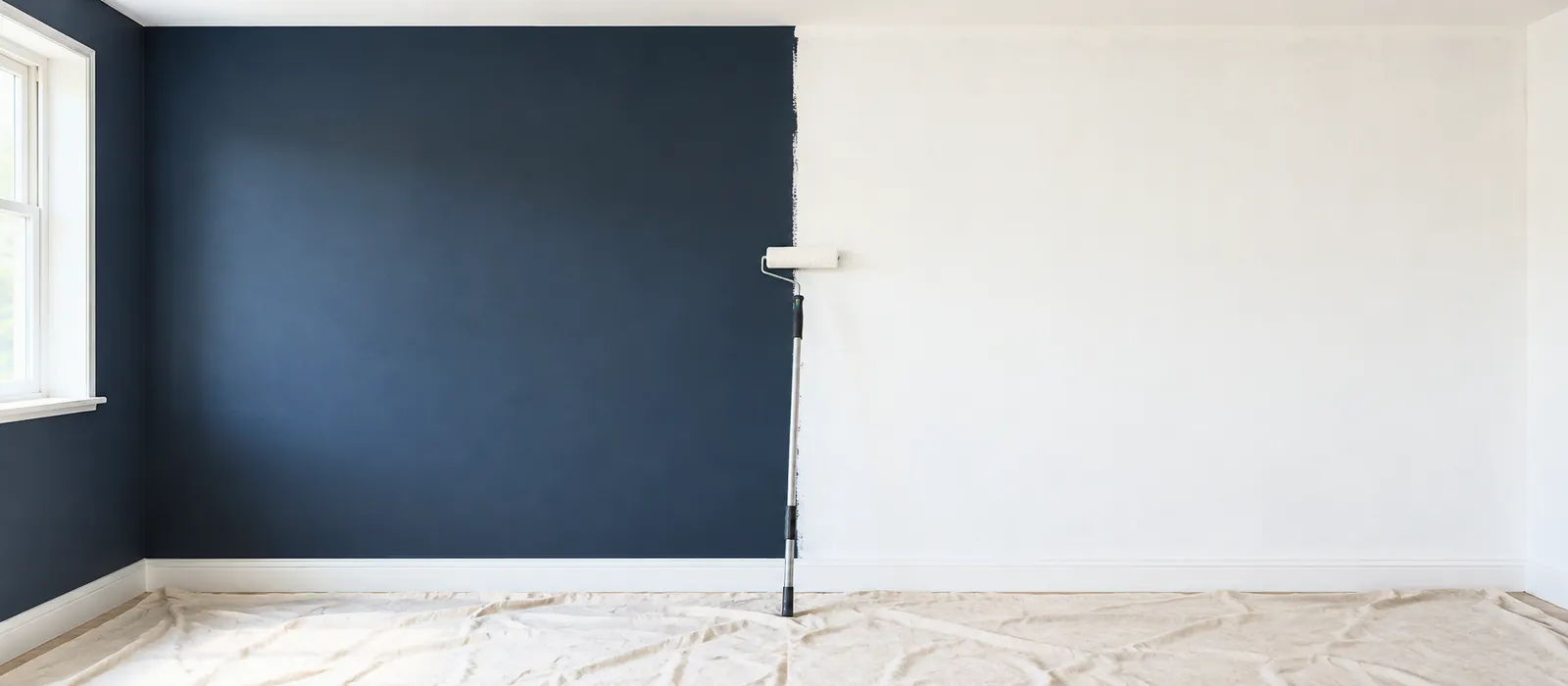
A dark wall is painted white in three coats, not ten: one coat of Wall Primer (or white Primer & Undercoat), which hides the colour and evens the surface, then two coats of Marble Matt Emulsion, rich in pigment and titanium white. The rest is preparation — dry filler, sanding, dusting — and one choice: white is never neutral; it takes its cue from the undertone of the colour you are leaving or the one you keep beside it.
Page updated September 2026 · by the Mylands France colour team
Understanding
Why white does not cover — and how it does
White is the colour that covers least: its pigment, titanium white, hides by reflection, and it needs a thickness the midnight blue beneath shows through. Hence the five or six coats people tell you about. The answer is not in the number of finish coats but in the primer: one coat of white primer, opaque, formulated for this, puts out the dark colour; then two coats of Marble Matt Emulsion — one of the most pigment-rich on the market — are enough, as on any wall.
Preparation counts even more than usual: a matt white in raking light shows every bump of filler and every roller mark the blue was hiding. A day of filling and sanding, the day before, is half the result — see Preparing a room for painting.
The method
From dark to white in six steps
-
01
Prepare, the day before
Room emptied or grouped in the centre, floor sheeted, sockets and switches removed (power off), hardware taken down. Fill cracks and holes and let the filler dry completely — damp filler makes a dull patch under white, the most visible patch of all. Sand the repairs with 120, the whole wall with 180, vacuum, damp cloth. Mask skirting and architraves.
-
02
Primer: the repairs first, then the whole wall
Thin the Wall Primer slightly (5 %, as the sheet says) and apply it with the mini roller to every filled area, to even out the filler's absorption. Then a full, undiluted coat over the whole wall with the short-pile roller, after cutting in with the brush. On a very dark base — midnight blue, forest green, red — white Primer & Undercoat, more opaque, does the same job with more margin. Recoatable after 3 to 4 hours.
-
03
Look at the wall in raking light
With the primer dry, switch on a lamp close to the wall: whatever shows now will show under the white. A bump is sanded, a hollow is filled, a roller mark is sanded with 180. Ten minutes here save a third coat. If the dark still shows through in patches, a second coat of primer beats an extra coat of finish.
-
04
First coat of white
Cut in the corners, the ceiling line and the skirting with the brush; then the roller in one-metre vertical bands, top to bottom, keeping a wet edge, and a final lay-off of each band in one direction, top to bottom, without pressing. The full method: How to paint a wall without marks. Touch-dry in 1 to 2 hours.
-
05
Second coat after 3 to 4 hours
Same movement, same direction. This is the coat that gives the white its depth and evenness. Remove the masking tape while it is still slightly damp, pulling at an angle.
-
06
Judge the next day, in daylight
Fresh white always looks a little grey or translucent on the evening of the second coat; in the morning, dry, it is white. If a veil of the old colour persists in raking light, a thin third coat settles it — rare with a well-applied primer. Put the plates back; keep the furniture a metre from the wall for a week.

Choosing the white
Which white after which colour
No Mylands white is neutral: each leans warm, cool, green or pink. The right white is the one that agrees with what stays in the room — often the neighbouring colour you are not repainting, or the memory of the one you are leaving. Ten off-whites compared: our guide.
| The wall was | The white that suits | Why |
|---|---|---|
| Midnight blue, blue-grey | Greenwich Time No.8 or St Clement No.11 | A slightly cool white keeps the memory of the blue without regretting it; a warm white would look yellow beside a door left blue |
| Red, terracotta, burgundy | Whitehall No.9 or Holland Park No.5 | A warm white carries the warmth on; reds tolerate bluish whites badly |
| Deep green, olive | Acanthus Leaf No.12 or Syon Park No.13 | A white with a hint of green goes with woodwork or a kitchen left green |
| Brown, chocolate, taupe | Holland Park No.5 or St James No.40 | A stone or cream white softens the change; pure white would look clinical |
| Dark grey, charcoal | Charterhouse No.4 or Elgin No.20 | A grey white stays in the family; a very pale grey can even read as white beside it |
| Black | Pure White No.1 or Maugham White No.2 | After a black the contrast wants to be crisp; a clean white, or barely off |
For the ceiling, often left white, check it does not clash with the walls' new white: which white for a ceiling. And test: a sample pot of white on a board, against the dark wall, tells you at once whether the undertone suits.
To avoid
The five mistakes that make ten coats
- Skipping the primer. It is what puts out the colour; without it, every coat of white stays translucent.
- Painting over damp filler. The dull patch it leaves under white shows from the door.
- Choosing a brilliant pure white by reflex. It shows every flaw and cools the room; a matt off-white forgives and warms.
- Going back over a band that is drying. On a matt white, the rework mark is permanent.
- Judging the same evening. Fresh white looks grey; wait for the morning.
Frequently asked questions
Your questions, our answers
How many coats of white over a dark wall?
One primer and two coats of finish — three in all. A third coat of finish only if a veil persists in raking light, which happens on a very saturated red or black without white Primer & Undercoat.
Which white covers best?
Every Mylands white carries the same pigment load; it is Marble Matt Emulsion itself that covers, up to 15 m² per litre. A slightly off white does seem to cover better than a pure white, though, because its grey or yellow hides a residual veil more easily.
Does a dark wall need sanding before repainting?
Yes, lightly, with 180, to break the sheen of the old paint and bring the repairs flush. A sound matt wall needs no more; a satin wall needs a firmer sanding, or the primer slides.
And the reverse — a white wall in a dark colour?
Same logic, tinted primer: Primer & Undercoat exists in dark grey, red, blue, green…; in the finish's tone, it gives a deep colour all its density in two coats. See How to paint a wall without marks.
Does the ceiling need repainting too?
Often, yes: a ten-year-old "white" ceiling looks yellow beside a new white. One coat of the same white, or of a ceiling white from the same family, brings it back level.
See also
Going further
 The day that decides the result: eight steps, the day before, so that tomorrow's two coats fit into one day.
 Preparation, primer, cutting in, vertical bands, wet edge, laying off in one direction: the Mylands method for...
 Painted with real paint, free, and far more useful than people think — once you know how to hold it.
 One colour, three depths: harmony guaranteed because the pigment is the same. Six Mylands families.
“White does not cover the dark; the primer does, and the white crowns it.”


